Jun 22, 2026 Press Release
Poverty Tracker Report Finds Rent-Stabilized Housing Keeps 140,000 Vulnerable New Yorkers Out of Poverty Each Year, Reducing the Poverty Rate Among Stabilized Tenants by 22%
First-of-its-kind Poverty Tracker spotlight report finds 40% of New Yorkers live in rent-stabilized housing. Report quantifies the anti-poverty impact of rent stabilization for New York City’s most rooted and vulnerable residents – long-tenured, low-income, elderly, and with limited pathways to higher earnings.
NEW YORK – Rent stabilization is a unique and underappreciated anti-poverty policy in New York City — that is a central finding of the first-of-its-kind Poverty Tracker spotlight report focused on rent stabilization released today by Robin Hood and Columbia University’s Center on Poverty and Social Policy. Between 2022 and 2024, the poverty rate among rent-stabilized tenants would have been roughly 8 percentage points higher absent this policy (37% vs. 29%), translating into 140,000 New Yorkers kept out of poverty each year.
The report, released three days before the NYC Rent Guidelines Board (RGB) is scheduled to vote on whether to raise or freeze rents for stabilized tenants, offers the most comprehensive data yet on who lives in rent-stabilized housing, how it shapes their economic lives, and the condition of the city’s rent-stabilized housing stock.
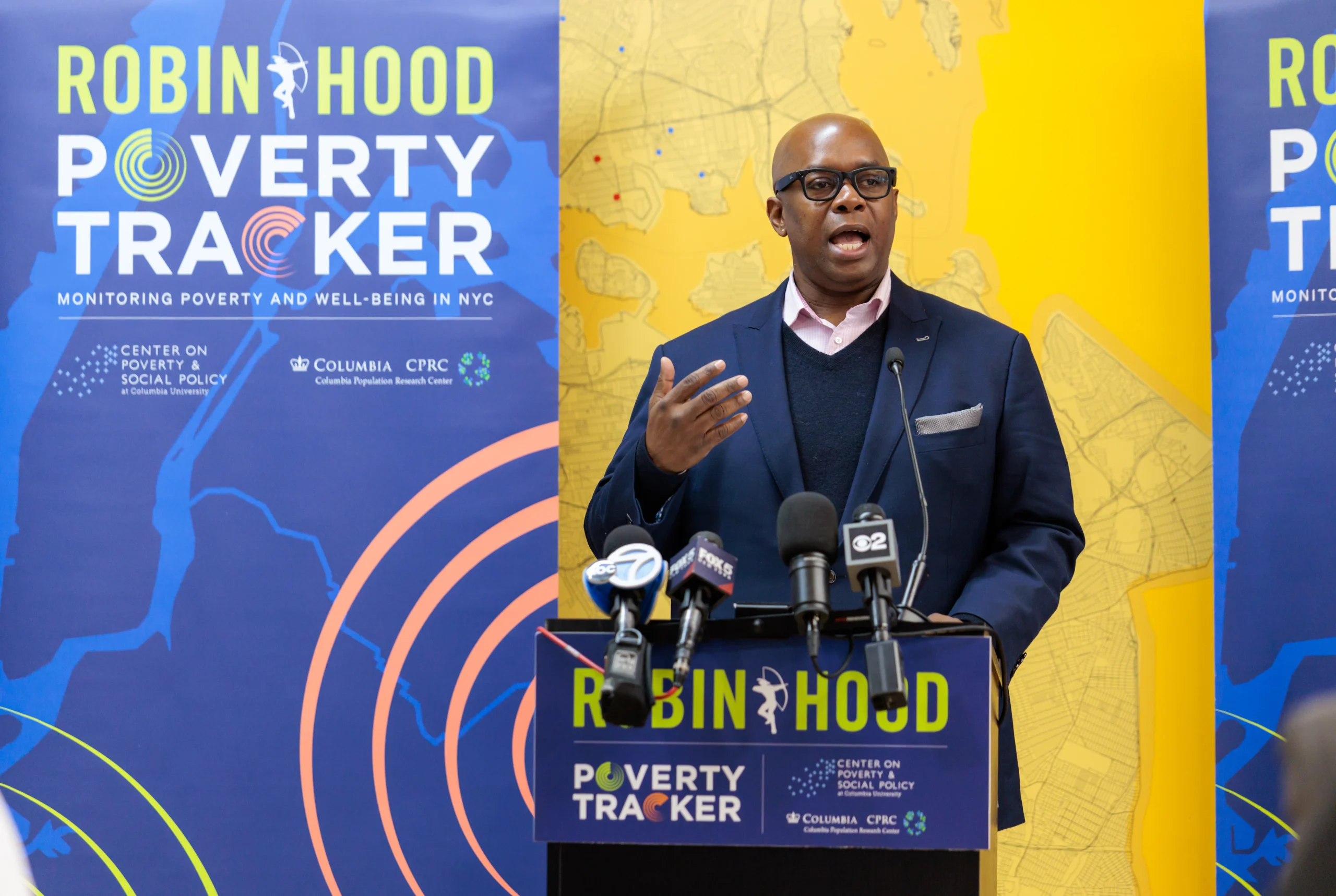
“We hope this data gives the Rent Guidelines Board a clearer picture of who lives in rent-stabilized housing and what is at stake for them. New York City faces a profound affordability crisis — families in stabilized apartments are already cutting back on food, utilities, and basic necessities just to stay housed. We know the board must weigh a number of factors as it makes its decision, and we want to make sure they do so with the best evidence available,” said Richard R. Buery Jr., CEO of Robin Hood.
Who Lives in Rent-Stabilized Housing
More than 40% of all New York City renters live in rent-stabilized apartments. These tenants are disproportionately the city’s longest-tenured and most vulnerable residents:
- 74% have lived in New York City for 10 or more years
- 28% live in a household with an adult over 65, compared to 16% citywide
- 16% are working-age adults kept out of the workforce by a health condition — three times the rate in market-rate housing
- Two-thirds (69%) are low-income, living below 200% of the poverty line
- One in five (21%) do not have a high school diploma
Rent Stabilization Keeps New Yorkers Above the Poverty Line — But Does Not Make Rent Affordable
While rent stabilization is a powerful anti-poverty tool, the report finds that it does not guarantee affordability in a city where housing costs are already out of reach for many low-income families. Four in ten rent-stabilized households are rent-burdened – spending over 30% of their income on rent – despite their reduced rent, and the vast majority are cutting back on essentials to keep up:
- 80% of rent-stabilized tenants made at least one change to their spending or saving to cope with rising costs; more than two-thirds (68%) made multiple adjustments
- More than half cut back across every essential domain, including food purchases (62%), transportation (58%), savings (60%), and electricity and utilities (54%)
The Condition of Rent-Stabilized Housing
The report also documents significant disparities in housing conditions between low-income and higher-income rent-stabilized tenants, revealing a two-tiered system in which those least able to advocate for themselves bear the brunt of deferred maintenance:
- Low-income renters in rent-stabilized housing reported seeing rodents at nearly double the rate of moderate- and higher-income renters in rent-stabilized housing (39% versus 21%)
- 41% of low-income rent-stabilized households had to use additional sources of heat in the winter; more than one in five (19%) had no air conditioner
- 16% of low-income rent-stabilized tenants reported that their building’s common areas were not safe, compared to just 3% of higher-income rent-stabilized tenants
“Our data show that rent stabilization helps a wide swath of New Yorkers keep their costs low and avoid the experience of poverty. But policy needs to do more to address the persistent financial challenges and housing quality issues facing many tenants. Regardless of whether the freeze is implemented, the city needs a multifaceted approach that will improve affordability, keep tenants in their homes, and support the development of additional affordable housing stock.” says Schuyler Ross, a research analyst at Columbia and one of the lead authors of the report.
The report draws data from Robin Hood’s Poverty Tracker, a longitudinal study conducted in partnership with Columbia University’s Center on Poverty and Social Policy that has followed a representative sample of New York City residents since 2012. This report is the only resource of its kind to analyze the relationship between rent stabilization and poverty in New York City. The report was released during a panel event at Robin Hood’s Union Square office, moderated by CEO Richard Buery and featuring NYC Deputy Mayor for Housing and Economic Development Leila Bozorg, Executive Director of the New York Housing Conference Rachel Fee, the President of Monadnock Development, Kirk Goodrich, and Columbia University researchers Schuyler Ross and Daniel Salgado.
Together, the data and the conversation it sparked underscore a defining tension at the heart of New York City’s housing crisis: rent stabilization is an indispensable lifeline for the city’s most vulnerable tenants — and yet the financial pressures facing building owners, including rising energy costs, property taxes, insurance expenses and deferred maintenance and investment, threaten the long-term viability of the very housing stock those tenants depend on. Resolving that tension is one of the most consequential challenges facing policymakers as the city works to ensure New York remains livable for all.
About the Poverty Tracker
Since 2012, the Poverty Tracker has surveyed a representative sample of 3,000 New York households multiple times a year, providing critical longitudinal insight into the dynamics of poverty and disadvantage in the city, tracking employment, assets and debts, health, and more. The Poverty Tracker is a joint project of Robin Hood and Columbia University’s Center on Poverty and Social Policy.
About Robin Hood
We are NYC’s largest local poverty-fighting philanthropy, and since 1988, we have invested $3 billion to elevate and fuel New Yorkers’ permanent escapes from poverty. In 2025, through $140 million in grantmaking to 295 community partners, we created pathways to opportunity through strategic partnerships on child care, child poverty, jobs, living wages, and more. We are scaling impact at a population level for the more than two million New Yorkers living in poverty. At Robin Hood, we believe your starting point in life should not define where you end up. To learn more about our work and impact, please visit robinhood.org and follow us on Instagram, LinkedIn, Facebook, YouTube, and X.
About Columbia University’s Center on Poverty and Social Policy
The Center on Poverty and Social Policy at the Columbia University School of Social Work produces actionable research to advance our understanding of poverty and the role of social policy in reducing poverty and promoting economic security, opportunity, and well-being in New York City and the United States. For the center’s latest work and policy briefs, visit povertycenter.columbia.edu and sign up for research updates. Email at cpsp@columbia.edu. Follow on LinkedIn and Bluesky.
Media Contact
Kevin Thompson/Crystal Cooper, press@robinhood.org