January 2026
Data Snapshot: Exiting and Falling Back into Poverty
This report examines New Yorkers exiting poverty in a single year, and whether they remain above the poverty line in the years that follow. While many people move out of poverty, a substantial share fall back into it within a short period of time.
Contributors: Christopher Yera, Sophie Collyer, Yajun Jia, and Schuyler Ross
Introduction
The Poverty Tracker is a longitudinal study of poverty and well-being in New York City conducted in partnership between Robin Hood and Columbia University. Unlike other studies, the Poverty Tracker surveys the same New Yorkers across multiple years, allowing for critical insights on the dynamics of income poverty 1 and other forms of disadvantage in the city. Prior Poverty Tracker studies, 2 for example, have shown that certain common life events—including having work hours cut or losing employment, welcoming a baby, and ending a relationship—are associated with an increased risk of falling into poverty. Transitions in and out of poverty across years means that, while the New York City poverty rate has been persistently high—20% or higher in all but three years since 2015—it is not the same New Yorkers living below the poverty line year after year. Instead, from one year to the next, a sizable share of New Yorkers exit poverty, just as a sizable share fall below the poverty line. 3
In this Data Snapshot, we leverage the Poverty Tracker’s longitudinal data to address an additional question about the dynamics of poverty in New York City: on average, what share of New Yorkers living below the poverty line exit poverty from one year to the next? And are New Yorkers who exit poverty likely to stay above the poverty line for multiple years, or are poverty exits more often temporary? Specifically, we estimate the share of adult New Yorkers who exit poverty in an average year and, among them, the proportion who either fall back below the poverty line within the next two years or remain above it. We also examine whether such trends have changed over time.
How many New Yorkers living below the poverty line exit poverty the following year?
While the New York City poverty rate has been elevated in recent years amidst the rising cost of living, about 20% of adult New Yorkers, or roughly 1.3 million, lived below the poverty line in an average year between 2015 and 2021 (Figure 1). 4 Using multiple years of Poverty Tracker data to follow the same adults over time, 5 we find that roughly half (51%) of New Yorkers living in poverty in a given year exit poverty the following year, while just under half (49%) continue to live in poverty. 6
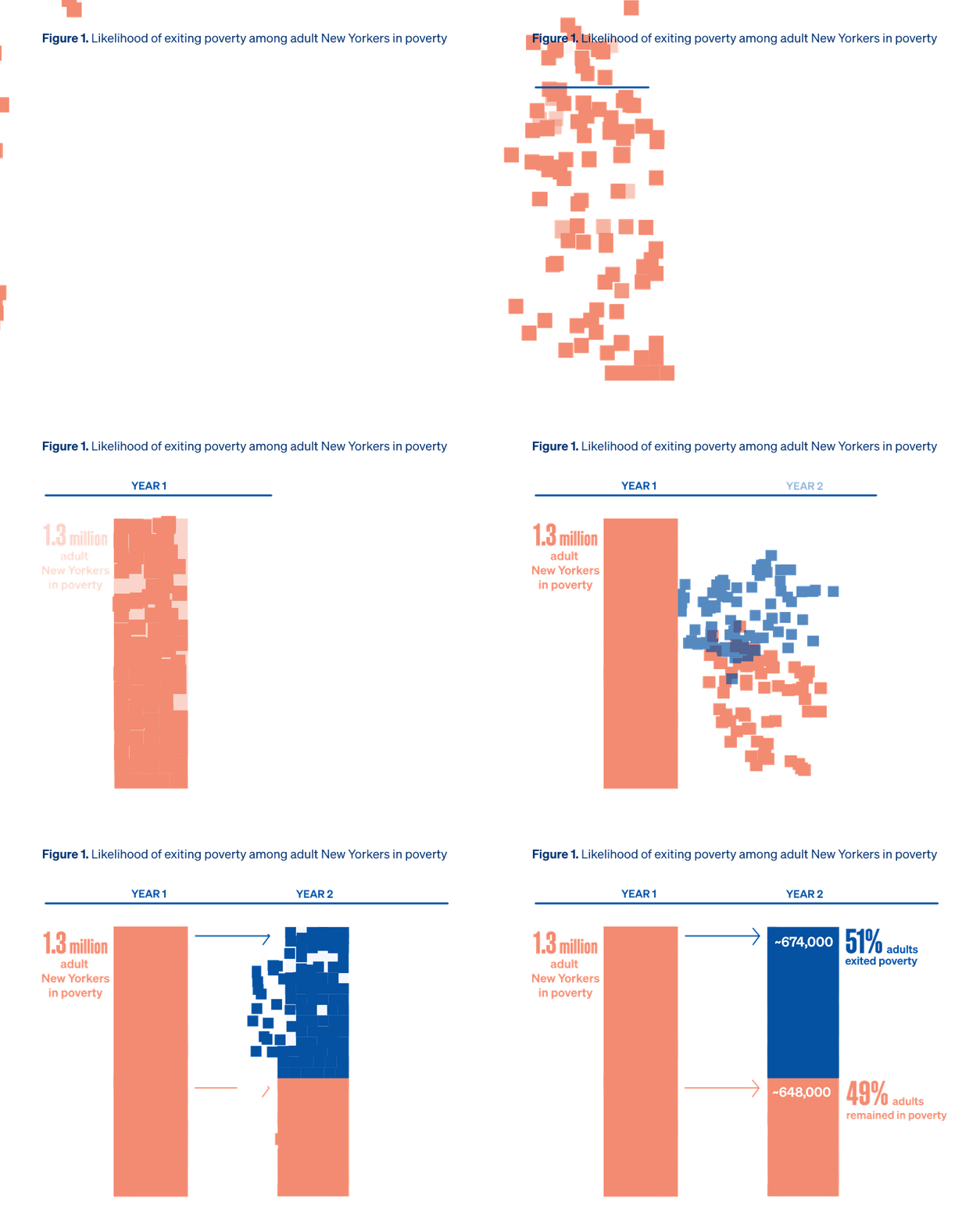
Source: Findings drawn from longitudinal Poverty Tracker data collected from the second, third, fourth, and fifth study cohorts. Note: Population counts are rough estimates based on the city’s average population size from 2015 to 2021.
Among New Yorkers who exit poverty, how many fall back below the poverty line soon thereafter?
Looking at subsequent years of data, we are also able to examine whether New Yorkers who exit poverty stay out of poverty long-term, or if their stays above the poverty line are more often short-lived. We find that a majority of adult New Yorkers who exit poverty soon fall back below the poverty line, with more than half (53%) falling back into poverty within two years of their exit (Figure 2). The remaining half (47%) who exit poverty continue to remain above the poverty line in the following two years.
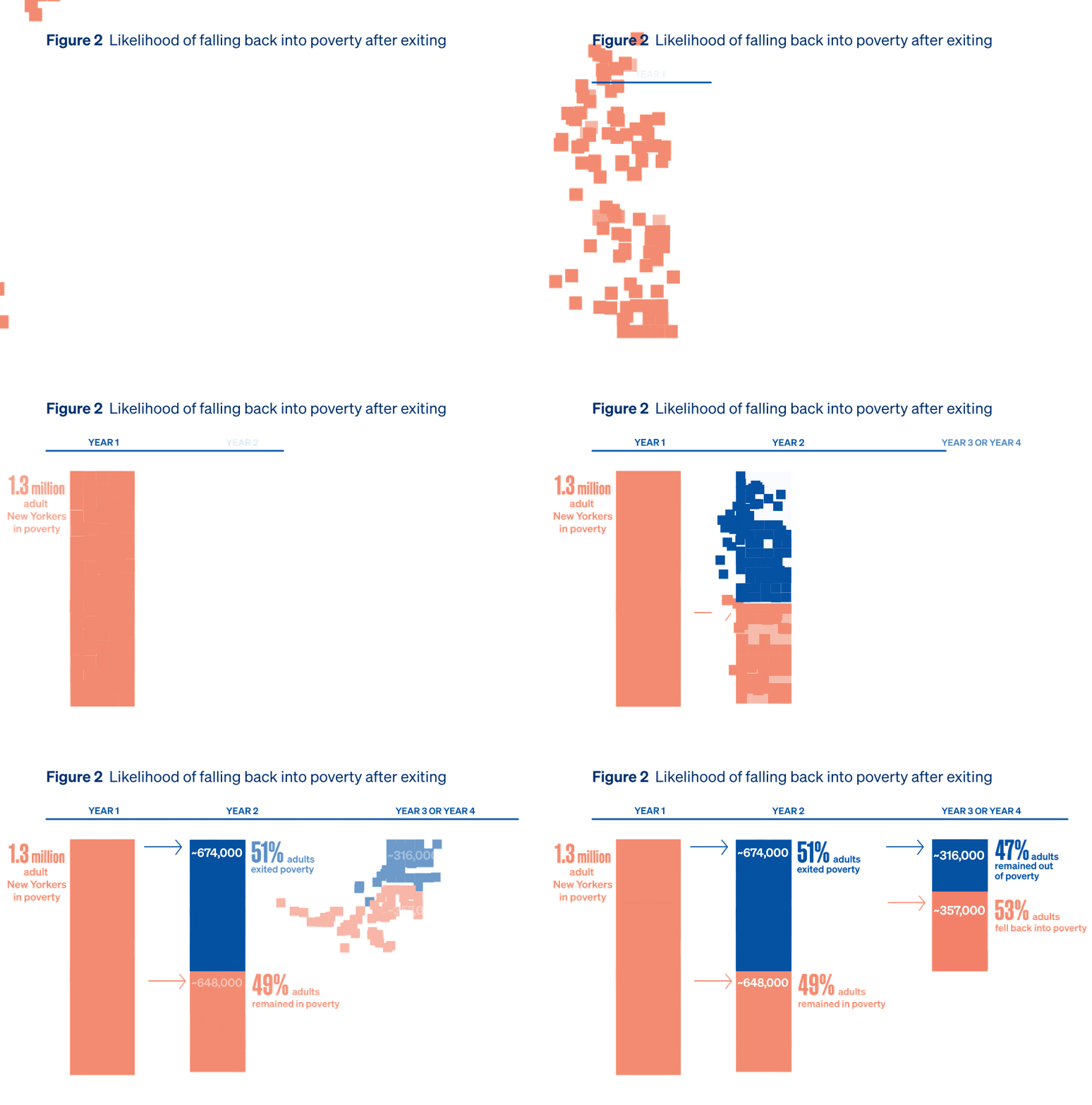
Note: Population counts are rough estimates based on the city’s average population size from 2015 to 2021. Source: Findings drawn from longitudinal Poverty Tracker data collected from the second, third, fourth, and fifth study cohorts.
How has the likelihood of falling back into poverty after exiting changed over time?
We are also interested in investigating if the likelihood of falling back into poverty after exiting has changed over time. Here, we examine how this likelihood compares for New Yorkers who exited poverty before the COVID-19 pandemic (i.e., between 2016 to 2019), those who exited during the peak of the pandemic (i.e., in 2020 or 2021), and those who exited after the peak of the pandemic (i.e., in 2022).
Figure 3 shows that just over half (52%) of adult New Yorkers who exited poverty before the pandemic fell back into poverty within two years of their exit. New Yorkers who exited poverty during the pandemic, however, were far more likely to fall back below the poverty line in the following two years. We find that nearly 2 in 3 (64%) adult New Yorkers who exited poverty during the peak of the pandemic fell back into poverty soon thereafter. This trend may be attributed to the fact that many of these New Yorkers were likely moved above the poverty line by unprecedented, temporary policy reforms that bolstered the safety net and helped stabilize incomes during the peak of the pandemic. 7 The subsequent rollback of these reforms, and associated loss of support, consequently plunged an even higher number of New Yorkers back below the poverty line. In the years since the peak of the pandemic, however, the likelihood of falling back into poverty after an exit has returned to pre-pandemic levels. We find that roughly half (49%) of adult New Yorkers who exited poverty after the peak of the pandemic, in 2022, fell back below the poverty line within two years.
Conclusion
This Data Snapshot reveals that while a sizable share of New Yorkers exit poverty from one year to the next, these exits from poverty are more often temporary than long-lasting. Leveraging longitudinal data from the Poverty Tracker, we find that more than half of adult New Yorkers who move out of poverty fall back below the poverty line within two years of their exit.
This snapshot also highlights how lasting policy interventions can not only move New Yorkers out of poverty, but also make them less likely to be pushed back into poverty. This is made clear when examining how the likelihood of falling back into poverty after an exit has fluctuated over time. Our data shows that approximately half of New Yorkers who exited poverty before and after the peak of the COVID-19 pandemic fell back below the poverty line within two years.
However, New Yorkers who exited poverty during the height of the pandemic—in large part because of temporary policy interventions—were much more likely to fall back into poverty after these policies were rolled back. While unprecedented policy reforms in 2020 and 2021 bolstered the safety net and helped both lift and keep New Yorkers out of poverty, their expiration left New Yorkers who were moved out of poverty more vulnerable than ever to falling back below the poverty line.
Ultimately, our findings suggest that more permanent and robust expansions to social programs, rather than temporary supports, could help make exits from poverty longer-lasting, especially when paired with increased access to stable, well-paying employment.
Why Stability is so Hard to Sustain: Stories of Economic Peaks and Valleys
A qualitative companion to this Data Snapshot, our Stories of Economic Peaks and Valleys report explores real-life anecdotes from more than 20 Poverty Tracker study participants, shedding greater light on the circumstances that cause New Yorkers to weave in and out of poverty.
Appendix A. The Supplemental Poverty Measure
Every September, the U.S. government releases the latest results on national poverty using the Official Poverty Measure (OPM). The OPM was developed in the 1960s and compared families’ total before-tax cash income with a poverty line, or threshold. The threshold was defined as three times the cost of a minimally adequate food budget during that time. With the exception of some minor adjustments, this measure has only been updated annually to account for changes in inflation. Over time, this formula has become increasingly outdated. Food costs have become less important in family budgets, while things like housing and child care have become costlier. A focus on before-tax cash income ignores benefits that many families receive through the tax system, such as the Earned Income Tax Credit, or in noncash form, such as nutrition assistance or housing vouchers. Importantly, the poverty threshold under the OPM does not vary with costs of living, particularly housing costs, which are notoriously high in New York City.
The Supplemental Poverty Measure (SPM) improves the measurement of poverty on all of these fronts. The poverty threshold is based on contemporary spending on food, as well as on other necessities like clothing, shelter, and utilities. The poverty threshold in places like New York City is also higher given its higher than-average housing costs, and the threshold is different for renters and homeowners. In 2024, for example, the SPM threshold for a two-adult, two-child family of renters in New York City was $50,283. In the SPM, tax credits and noncash benefits are also counted as income, and for families who incur them, medical, work, and child care costs are subtracted from income. The Poverty Tracker collects all the requisite data necessary to directly calculate the SPM in its sample of New Yorkers, and this data forms the basis of our income poverty statistics.
The Poverty Tracker measures poverty in New York City using the SPM. The New York City government also tracks trends in the city’s poverty rate using the NYCgov Poverty Measure. There are slight differences between the construction of the SPM and the NYCgov Poverty Measure, thus they produce slightly different annual poverty rates. The differences between the NYCgov Poverty Measure and the SPM are discussed in the NYCgov Poverty Measure annual report. 8