January 2026
Childcare Hardship in NYC: Preliminary Findings from the Poverty Tracker
Newly-developed Poverty Tracker annual survey questions will shed light on child care access and affordability for New Yorkers
Contributors: Schuyler Ross, Sophie Collyer, Yajun Jia, Christopher Wimer
Issues Areas: Early Childhood, Special Reports
Since its inception, the Poverty Tracker has collected robust information on five types of material hardship: food, housing, bills, finances, and healthcare. While these measures combine to paint a detailed picture of economic insecurity in New York City, they fail to capture the sacrifices that many families are forced to make in trying to provide childcare for their children. Rising costs in recent years have made such “childcare hardship” a prevalent concern. Thus, beginning in 2024, the Poverty Tracker team added two newly-developed questions to our annual surveys designed to capture New Yorkers’ experience of this plight.
The first question asks, “In the past 12 months, have you had to stop using a childcare arrangement or cut back on childcare hours because you could not afford it?” The second asks, “In the past 12 months, have you had to rely on a childcare arrangement that you felt was inadequate because you had no other affordable options?” Taken together, the questions aim to evaluate how affordability challenges affect childcare arrangements among New York City parents. Below we present responses to these questions collected in reference to calendar year 2024, overall and cut by various demographics and outcomes. To represent the core working-age parent population for whom childcare costs are most salient, we limit the sample to families with at least one working parent and at least one parent between the ages of 25 and 55. The questions were shown to all respondents with at least one child under the age of 12.
Key findings from the analysis include:
- Roughly 15% of parents experienced each form of childcare hardship, and more than one-fifth (21%) experienced at least one form.
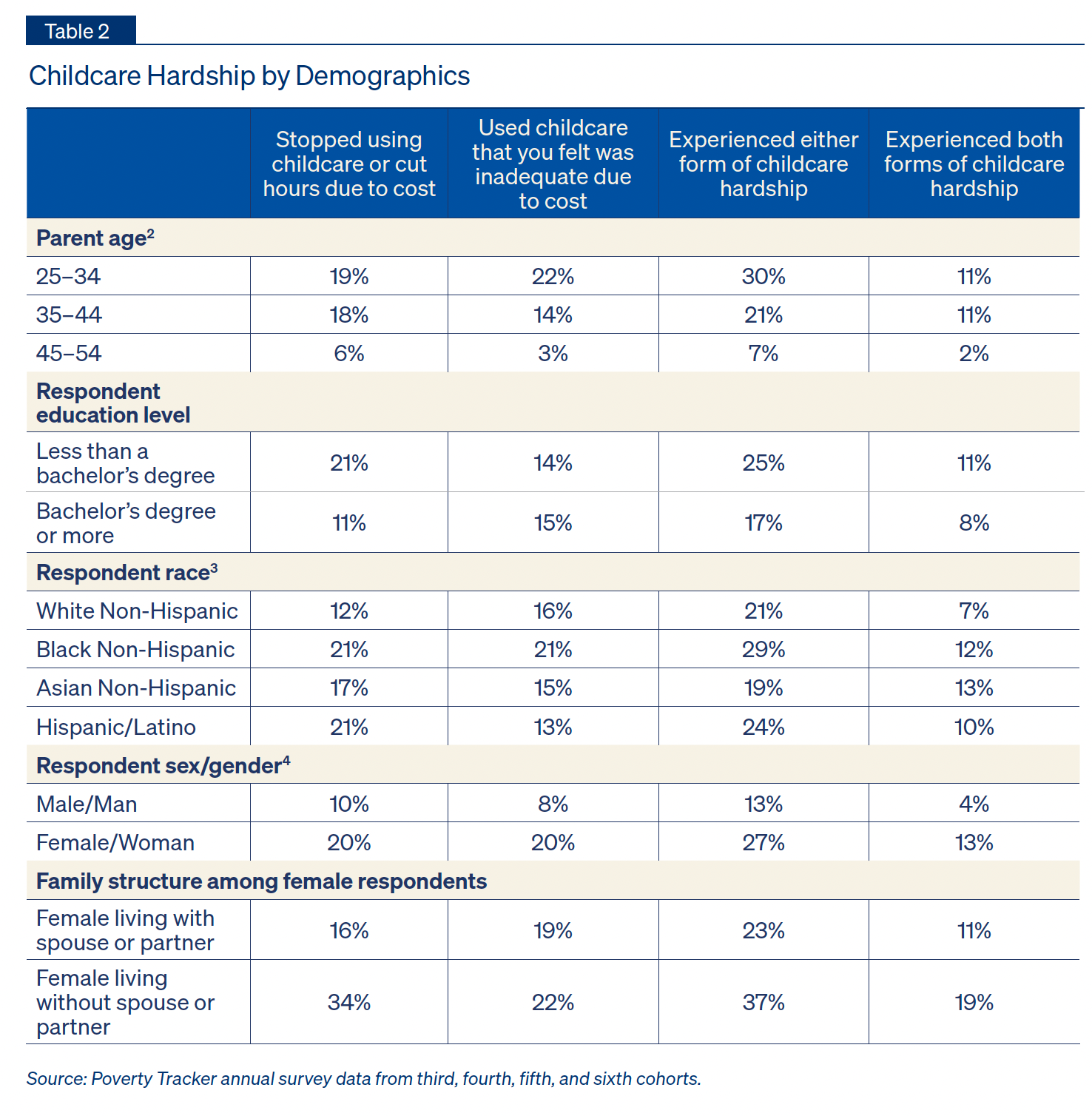
- Rates of experiencing either hardship were elevated among certain subgroups: younger parents (30%), Black parents (29%), single mothers living without a spouse or partner (37%), and parents who worked for only a portion of the year (34%).
- There is a clear intersection between childcare hardship and the study’s other key forms of disadvantage. 37% of parents living in poverty, 48% of parents living through material hardship, and 45% of parents living with a health problem experienced at least one form of childcare hardship during the year.
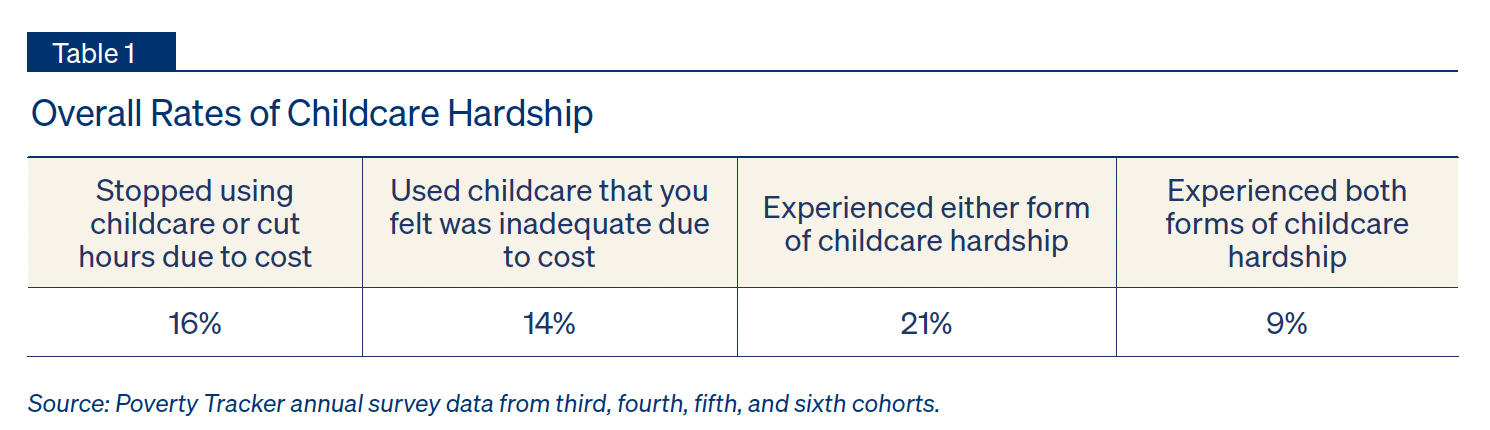
A look at the overall numbers in Table 1 reveals that childcare hardship was prevalent among New York City parents in 2024. Roughly 15% of parents experienced each form of hardship, respectively, and more than one-fifth (21%) experienced at least one form. 9% of parents had to navigate both forms of hardship.
Cutting the hardship rates by demographics yields additional insights. Table 2 reveals that certain subgroups experienced higher rates of childcare hardship across the board, including: younger parents ages 25 to 35, parents who do not hold a Bachelor’s degree, and Black parents. Interestingly, female respondents reported over twice the rate of childcare hardship as their male counterparts (27% vs 13%) — but this may be due to reporting bias rather than a real-world pattern (e.g., fathers may be less attuned to childcare needs and costs than mothers). Splitting female respondents by presence of a spouse or partner shows that family structure matters too. 1 While mothers in all arrangements were more likely to report childcare hardship than fathers, single mothers living without a spouse or partner experienced higher hardship rates (37%) than nearly any other demographic group. And compared to all New York City parents (Table 1), single mothers were more than twice as likely to stop using childcare or cut back on childcare hours due to cost (34% vs 16%).
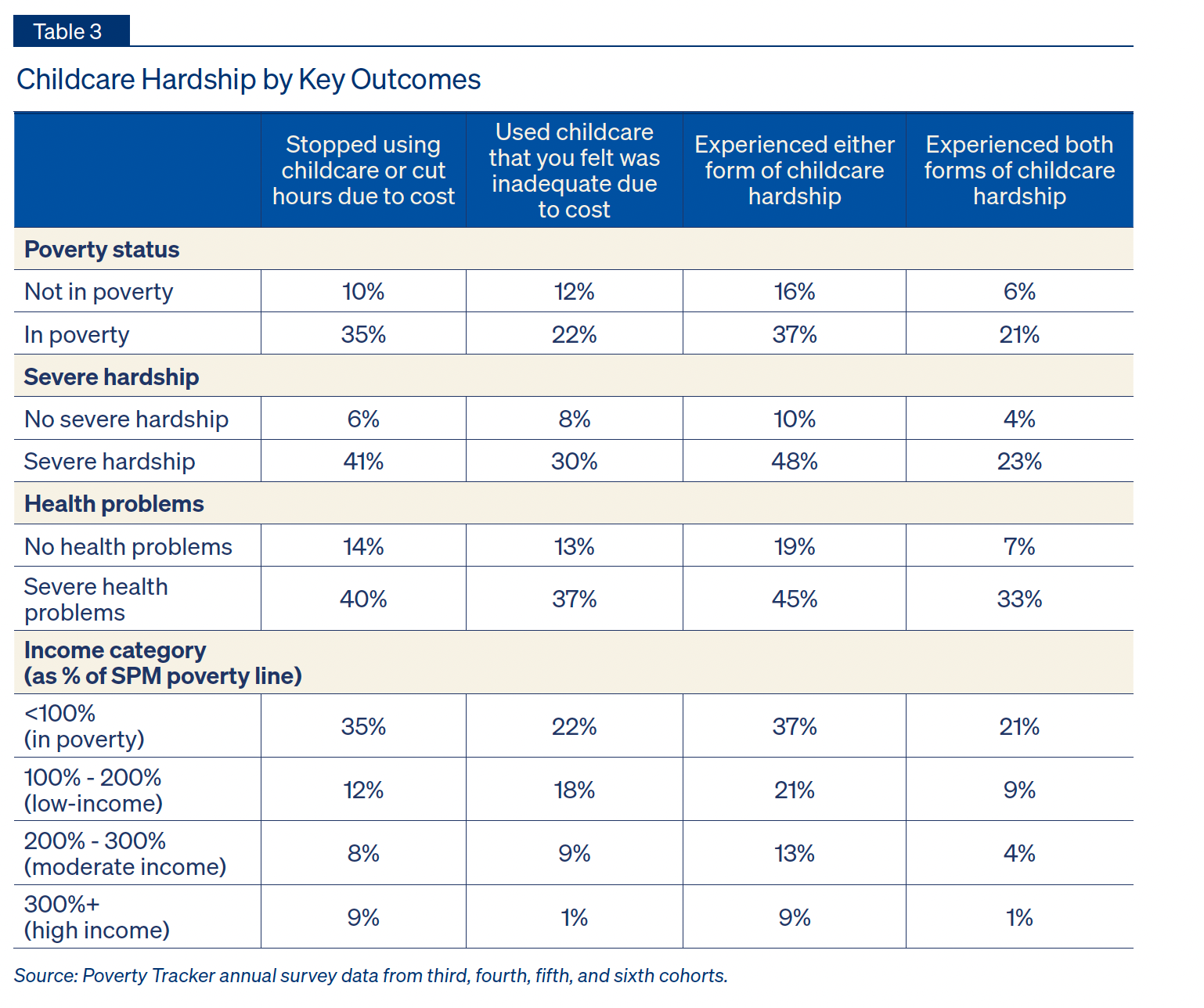
Discrepancies in childcare hardship are most pronounced when looking at intersections with the Poverty Tracker’s key measures of disadvantage: SPM poverty, material hardship, and health problems. The data in Table 3 illustrate the compounding nature of economic struggles. Over one-third (37%) of parents living in poverty experienced at least one form of childcare hardship, compared to one-sixth (16%) of parents living above the poverty line. Breaking down the income brackets further, the data shows a clear relationship between financial need and childcare hardship prevalence. Rates of either hardship remain fairly high for low-income New Yorkers (between 100 and 200% of the poverty line) at 21%, decrease somewhat for moderate-income New Yorkers (between 200 and 300% of the poverty line) to 13%, and fall to just 9% for the highest-income New Yorkers (above 300% of the poverty line).
Looking beyond income, nearly half of parents (48%) facing severe material hardship — in the domains of food, housing, bills, finances, and healthcare referenced earlier — reported facing childcare hardship as well. This is compared to 10% of parents who do not face another type of severe hardship. And 45% of parents living with a health problem encountered childcare hardship in the past year, more than twice the rate of parents without health problems (19%).
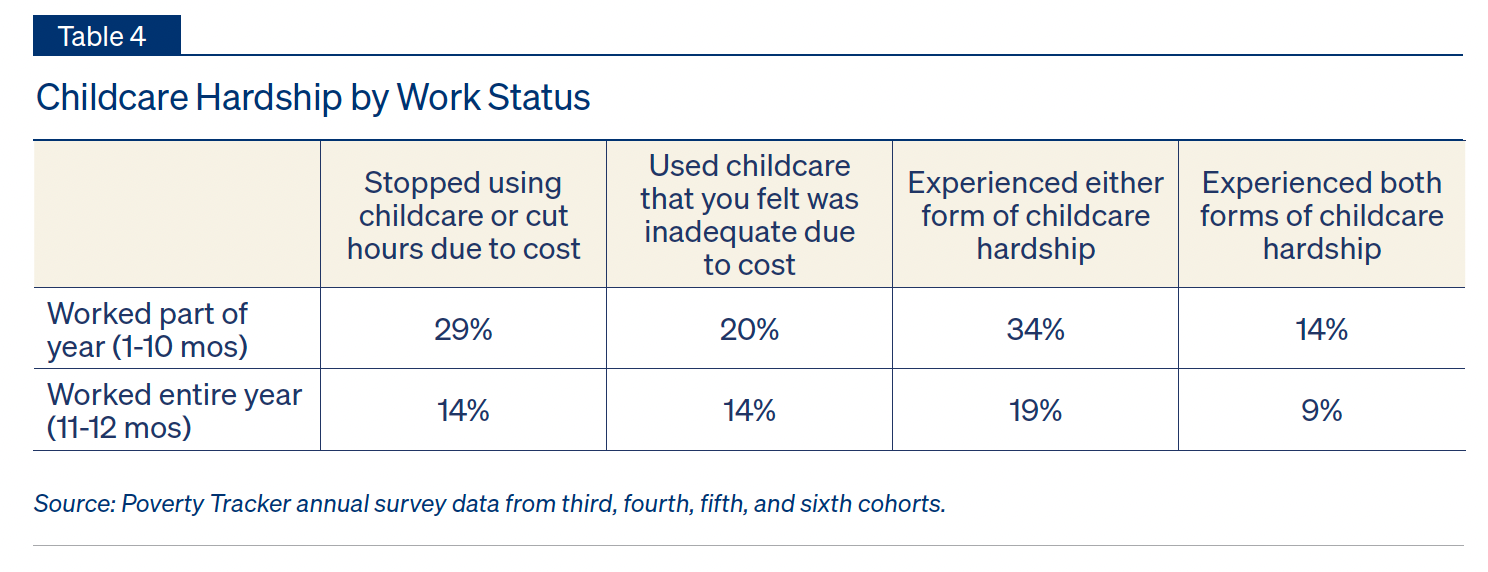
Finally, Table 4 investigates how childcare hardship varies based on parental work status. For families with two parents, we use the work status of the parent who worked the greatest number of months in the year. What stands out here is that hardship rates are higher among parents who worked for ten months or fewer (34%) than among parents who worked for the entire year (19%). The dynamic underlying this trend is likely two-faceted: parents who experience difficulty accessing childcare may be unable to work consistently through the year, and this inconsistent work schedule may in turn make securing reliable childcare more difficult.
Overall, the results presented here show a city where a sizeable share of parents are struggling to afford reliable, high-quality childcare. More than one-fifth of working parents aged 25-55 reported experiencing some form of childcare hardship in 2024, with even larger shares of young parents, Black parents, parents who do not hold a Bachelor’s degree, and single mothers being afflicted. Families struggling to cope with other forms of disadvantage were hit the hardest — more than one-third of parents living in poverty and nearly half of parents experiencing severe material hardship and health problems also faced childcare hardship during the year. As prices continue to rise and threats of cuts to federal childcare funding loom, state and local initiatives to expand childcare access quickly and equitably will become all the more important.