June 2026
Spotlight on: Rent Stabilization in New York City — Who Does it Serve, How Does it Improve Affordability, and Where Does it Fall Short?
More than 140,000 New Yorkers are kept out of poverty each year by rent-stabilized housing — yet residents still face disproportionately high rates of material hardship, rent burden, and deteriorating housing conditions, with the lowest-income tenants hit hardest.
Contributors: Schuyler Ross, Daniel Salgado, Ryan Vinh, Sophie Collyer, Yajun Jia, Christopher Wimer
Issues Areas: Housing Hardship
Introduction
Affordability is a kitchen-table issue for families across all income levels, and the rising cost of living has brought this discussion to the forefront of political campaigns and policy initiatives nationwide. These efforts are as urgent as ever today, as looming cuts to federal assistance programs will exacerbate struggles with healthcare and food affordability in the coming years.
A prominent part of the affordability discussion in New York City has centered on rapid rent increases and the limited availability of affordable housing. Over the past decade, median rent in New York City rose by 13.5% after adjusting for inflation, while wages have risen by roughly 4%. 1 And according to the 2023 New York City Housing and Vacancy Survey, rental vacancy rates in the city are at a historic low, at 1.4% among all units citywide and under 1% for units with rents less than $2,400. 2
While the housing affordability crisis has been a long-standing issue, New York City is also unique in having the largest rent regulation program in the country — more than 40% of New York City renters live in rent-stabilized units. Unlike market-rate rental units, year-to-year rent increases for rent-stabilized housing are set by the City’s Rent Guidelines Board (RGB), whose members are appointed by the Mayor. In recent years, tenants have experienced consistent rent increases, with the Rent Guidelines Board setting a 3% hike on one-year leases each year between 2022 and 2024, and a 2.75% hike on one-year leases in 2025. 3
Beginning last year, however, Mayor Mamdani’s promise to “Freeze the Rent” placed a spotlight on rent-stabilized housing as a potential solution to the affordability crisis. Freezing the rent will surely prevent housing costs from increasing for current residents of rent-stabilized housing and reduce their risk of poverty. Yet at the same time, the program does not guarantee affordability. Tenants in rent-stabilized units will likely continue to face high rates of rent burden and financial scarcity regardless of whether the rent is frozen or increased, as documented in this report. And a prolonged period of frozen rent would likely impact some building operators’ ability to meet maintenance costs, exacerbating housing quality issues that many tenants already contend with. Ultimately, additional policy solutions will be needed regardless of the rates set by the RGB. 4
It is also important to note that rent-stabilized apartments are not uniform in their quality, management, or history. A recent report from New York University’s Furman Center shows that roughly two-thirds of rent-stabilized units are located in buildings constructed before 1974, and most of these units are in buildings where 90 percent or more of apartments are rent-stabilized. 5 The remaining one-third of rent-stabilized units are located in government-subsidized buildings, where all or some apartments are subject to rent stabilization and where owners have received public financing or tax incentives. Rent stabilized units in these buildings are also typically income restricted. This variation means that the maintenance needs and fiscal circumstances of the city’s rent-stabilized housing stock vary substantially across buildings. As such, there is no single, one-size-fits-all policy solution that can simultaneously address the affordability challenges and maintenance issues facing tenants.
The following spotlight draws on recent Poverty Tracker data to present a portrait of the families residing in rent-stabilized housing in New York City, including both the ways that rent stabilization benefits them and the challenges they continue to face. We demonstrate the value of rent-stabilized housing and how comparatively lower rents help to keep many New Yorkers living in these units out of poverty. Yet we also find that rent-stabilized tenants, regardless of poverty status, must still contend with material hardships, health issues, and affordability challenges. Our analysis describes the prevalence of material hardships among the rent-stabilized population, the cutbacks they’ve had to make to cope with rising prices, and the high burden that rent costs place on their household resources (even with comparatively lower rents). Looking beyond financial strains, we then turn to the housing conditions and quality problems afflicting rent-stabilized tenants, which are indicative of a larger issue with the maintenance of these types of units.
We close with a set of policy recommendations — ranging from expanding rental assistance to establishing municipally-backed insurance programs and strengthening building code enforcement, among others. This set of recommendations is aimed at addressing both the broader challenges facing New Yorkers living in rent-stabilized housing and the condition of the rent-stabilized housing stock, with the long-term goal of strengthening and preserving this essential pillar of New York City housing policy.
140,000
New Yorkers kept out of poverty each year by rent stabilization
2.4M
NYC residents living in rent-stabilized apartments
40%+
of all NYC renters live in rent-stabilized housing
Key Findings
- Rent stabilization is a unique and underappreciated anti-poverty policy in New York City. Between 2022 and 2024, the poverty rate among rent-stabilized tenants would have been roughly 8 percentage points higher absent this policy (37% vs 29%), translating into 140,000 New Yorkers kept out of poverty each year.
- Despite the benefits of rent stabilization, New Yorkers in rent-stabilized housing continue to face multiple economic challenges:
- Residents of rent-stabilized housing are disproportionately long-time city residents, many of whom are older adults over the age of 65, have lower levels of educational attainment and are navigating part-time work.
- Roughly two-thirds of New Yorkers in rent-stabilized housing are getting by on low incomes and living below 200% of the poverty line. On average, beneficiaries of rent stabilization had lower incomes than New Yorkers citywide.
- Rent-stabilized tenants face elevated rates of material hardship, health problems, and serious psychological distress relative to citywide averages.
- Even with rent stabilization, rent eats up a large share of tenants’ monthly income. More than 40% of rent-stabilized households are rent-burdened, spending more than 30% of their income on rent, including more than three-quarters (79%) of families in rent-stabilized housing who are living in poverty.
- Housing quality concerns — such as having pests, limited heating and cooling, and unsafe public areas — are more prevalent among New Yorkers in rent-stabilized housing relative to residents in other housing types. These conditions are most common among lower-income New Yorkers in rent-stabilized housing, highlighting the need to address maintenance concerns alongside those related to economic stability.
Rent stabilization serves many of the city’s most economically vulnerable residents
Roughly 40% of New York City renters live in rent-stabilized housing — that is, rent-stabilized housing makes up a sizable share of the city’s rental housing stock. In many ways, the profiles of individuals and families living in rent-stabilized housing are similar to those of New Yorkers in market-rate housing. But there are also some notable differences between these populations, as well as the citywide population that includes non-renters, as presented in Table 1. For example, roughly 1 in 5 families both in rent-stabilized housing and in market-rate units have children. However, elderly individuals over age 65 make up a much larger share of the rent-stabilized population than the market-rate population (28% vs. 16%). The prevalence of older adults in these units suggests that rent stabilization disproportionately provides housing for those who may be more economically vulnerable or living on fixed incomes.
A substantially larger share of New Yorkers without postsecondary degrees live in rent-stabilized apartments, compared to other types of housing. More than 1 in 5 (21%) tenants in rent-stabilized housing do not have a high school degree, compared with 14% of tenants in market-rate apartments and citywide. On the other hand, tenants with a college degree made up a smaller share of the rent-stabilized population (34%) than of the market-rate population and the citywide population (42%).
Similarly, working-age adults who worked for the full year made up a smaller share of the population living in rent-stabilized apartments (59%) than in market-rate apartments (72%) and citywide (67%). This can likely be attributed to the uniqueness of the rent-stabilized population, which includes a disproportionate share of working-age New Yorkers who were facing health problems and could not work. This group makes up 16% of New Yorkers in rent-stabilized housing, but only 5% of New Yorkers in market-rate housing, and 10% citywide. Indeed, the fact that the rate is three times higher in rent-stabilized units than in market-rate units demonstrates that rent stabilization plays a critical role providing housing for New Yorkers who are unable to work because they are experiencing health issues.
The vast majority of tenants in rent-stabilized housing are also long-term residents of New York City: 74% reported living in New York City for 10 years or more, compared to 64% of tenants in market-rate units. Given the nature of rent stabilization, this trend is not surprising. Comparably lower monthly rents and regulated annual rent increases are hallmarks of the rent stabilization program, which likely help keep New Yorkers in their homes in the long term.
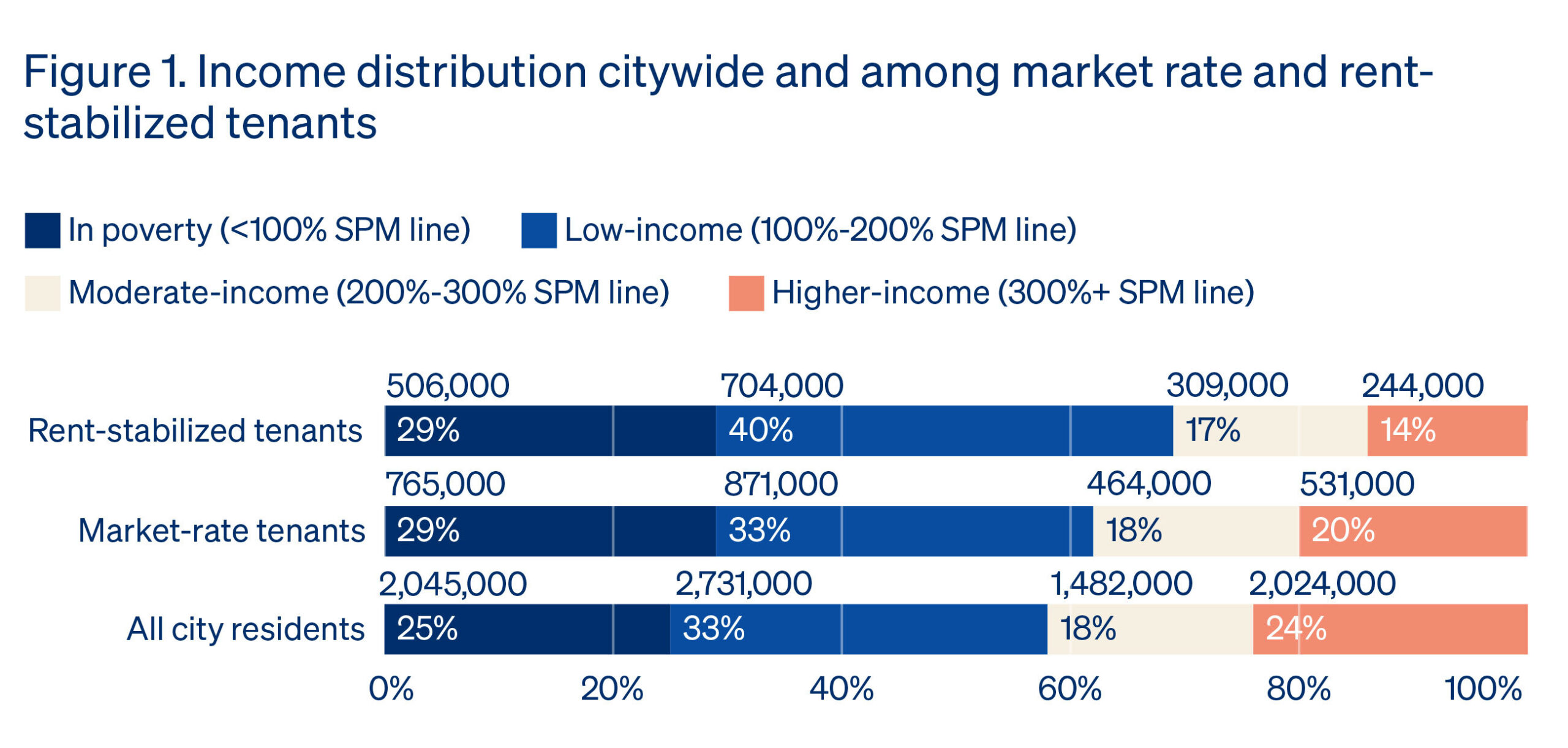
Another key characteristic distinguishing residents of various housing types is income level and poverty. Poverty is an important indicator of economic well-being and the ability to meet basic needs. The Poverty Tracker calculates poverty in New York City using the Supplemental Poverty Measure (SPM), an improvement on the Census Bureau’s Official Poverty Measure (OPM) that accounts for geographic variation in costs of living and the value of government taxes and transfers. 6 For a two-adult, two-child family living in rental housing in the city, the poverty line in 2024 was $50,283. Our data show that a sizable proportion of tenants in rent-stabilized units live below the poverty line, averaging 29% across 2022, 2023, and 2024 (Figure 1). This is higher than the citywide proportion of 25% and comparable to the market rate proportion of 29%.
While the poverty threshold provides an approximation of economic deprivation, it does not fully capture the experience of individuals whose incomes exceed the threshold but who still face other forms of disadvantage. We find that 200% of the poverty line is a more representative inflection point in terms of where New Yorkers’ experiences of hardship, health problems, and challenges with affordability begin to decline. And as Figure 1 shows, over two-thirds (69%) of rent-stabilized tenants are living below 200% of the poverty line (i.e., in poverty or with low incomes). This compares to 62% of market-rate tenants and 58% of residents citywide.
Source: Poverty Tracker annual survey data from the second through sixth cohorts, presented at the individual tenant level. We present averages across calendar years 2022-2024. 7
Overall, rent stabilization serves many New Yorkers who are hovering around the poverty line, are older or less educated, are working consistently or navigating a work-limiting health-condition, and are long-time residents of the city. This profile suggests that rent stabilization may be playing a key role in ensuring that the New Yorkers most economically vulnerable to being pushed out of the city by rising housing prices have been able to continue to stay in their homes.
Rent stabilization plays a critical role in reducing poverty in New York City
While poverty rates are relatively high among New Yorkers in rent-stabilized housing, rent stabilization is also a unique and under-appreciated antipoverty tool. It plays an essential role in alleviating poverty, helping to bring down a rate that would otherwise be significantly higher. Under the SPM metric used to evaluate poverty in the Poverty Tracker, rent stabilization has an implicit value that is counted in a family’s resources when determining their poverty status. This value is quantified as the difference between a tenant’s actual housing costs and the value of their housing needs, with those needs estimated using market-rate prices and the shelter/utilities portion of the SPM poverty threshold. 8 The value of rent stabilization is added to a family’s financial resources when determining if they are above or below the poverty line. Thus, we can also “remove” the value of rent stabilization to approximate the poverty rate without it, allowing us to quantify the extent to which the program keeps tenants above the poverty line.
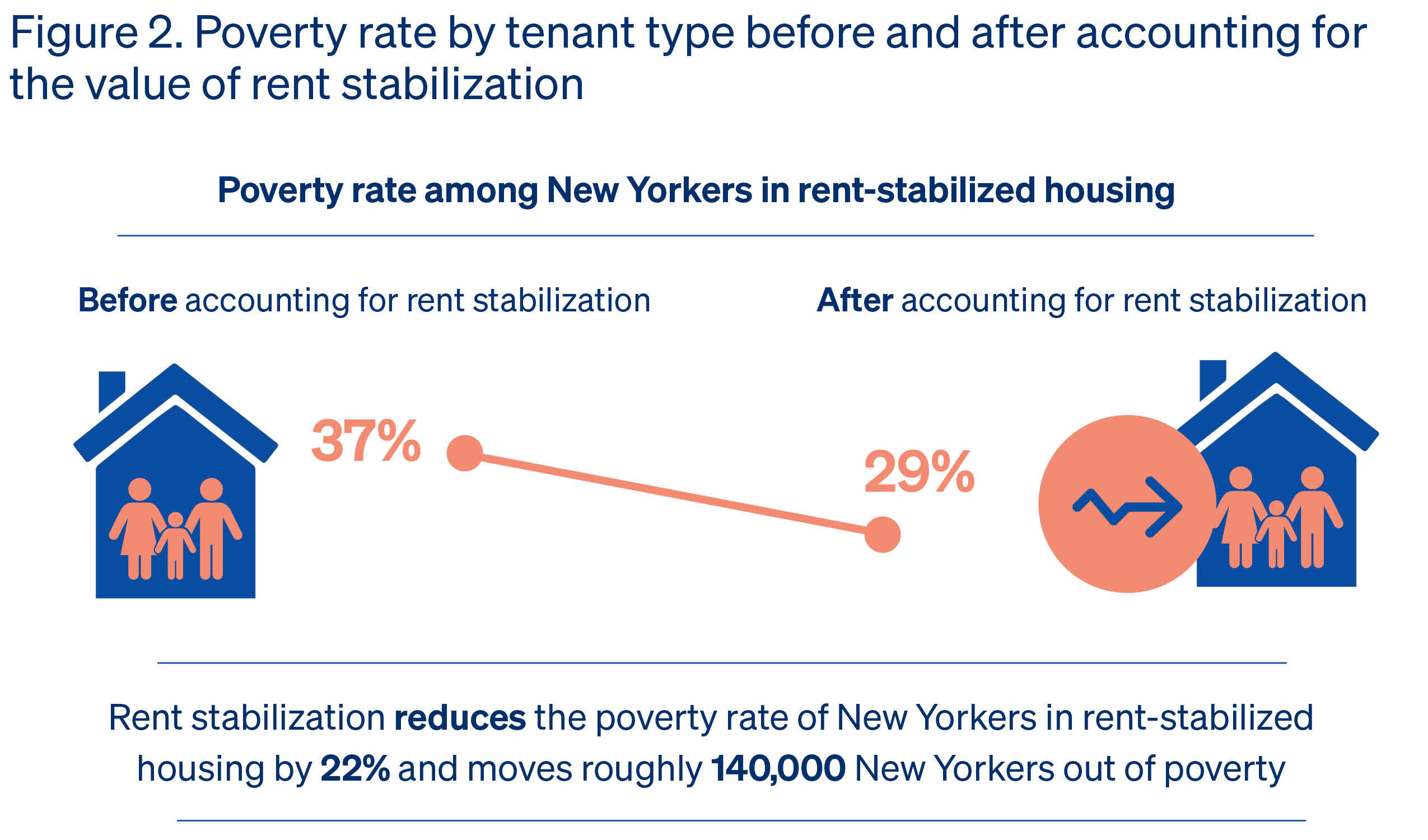
Figure 2 depicts the poverty rate among rent-stabilized tenants before and after accounting for the value of rent stabilization. The results show that the poverty rate among rent-stabilized tenants would be substantially higher absent the value of rent stabilization, increasing from 29% to 37%. This represents roughly 140,000 more adults and children who would be living in poverty without rent stabilization.
Source: Poverty Tracker annual survey data from the second through sixth cohorts, presented at the individual tenant level. We present averages across calendar years 2022-2024.
Beyond poverty, New Yorkers in rent-stabilized housing are disproportionately affected by various forms of economic disadvantage
Poverty is not the only indicator of economic disadvantage measured by the Poverty Tracker, and examining how New Yorkers in rent-stabilized housing are faring in other dimensions of disadvantage is key to understanding the wider challenges they may be facing. Two other key indicators of economic disadvantage are respondents’ experiences of severe material hardship and health-related challenges. Severe material hardship is defined as the inability to meet basic needs due to financial constraints, and is tracked across the five domains of food, housing, bills, general finances, and medical care, while health-related challenges include both physical health problems and serious psychological distress. 9 10
In Figure 3, we present rates of severe material hardship, health problems, and serious psychological distress citywide and among New Yorkers in rent-stabilized housing. We also divide the rent-stabilized group into low-income tenants living below 200% of the poverty line, and moderate-/higher-income tenants living above 200% of this threshold. The data reveal that across all three domains of disadvantage, rent-stabilized tenants are experiencing higher rates than the citywide average. More than 1 in 3 (35%) of rent-stabilized tenants reported at least one form of severe material hardship, more than 1 in 4 (27%) reported living with a health problem, and nearly 1 in 6 (15%) reported experiencing serious psychological distress. Zeroing in on tenants living below 200% of the poverty line, we find that experiences of disadvantage are even more common. Thirty-nine percent of low-income rent-stabilized tenants reported severe material hardship and 33% reported a health problem — both well above the rates of disadvantage found in the moderate- and higher-income groups (25% and 15%, respectively). Families in the city who hold the fewest financial resources are also clearly the most vulnerable to overlapping affordability and health-related challenges.
Source: Poverty Tracker annual survey data from the second through sixth cohorts, presented at the individual tenant level. We present averages across calendar years 2022-2024. 11
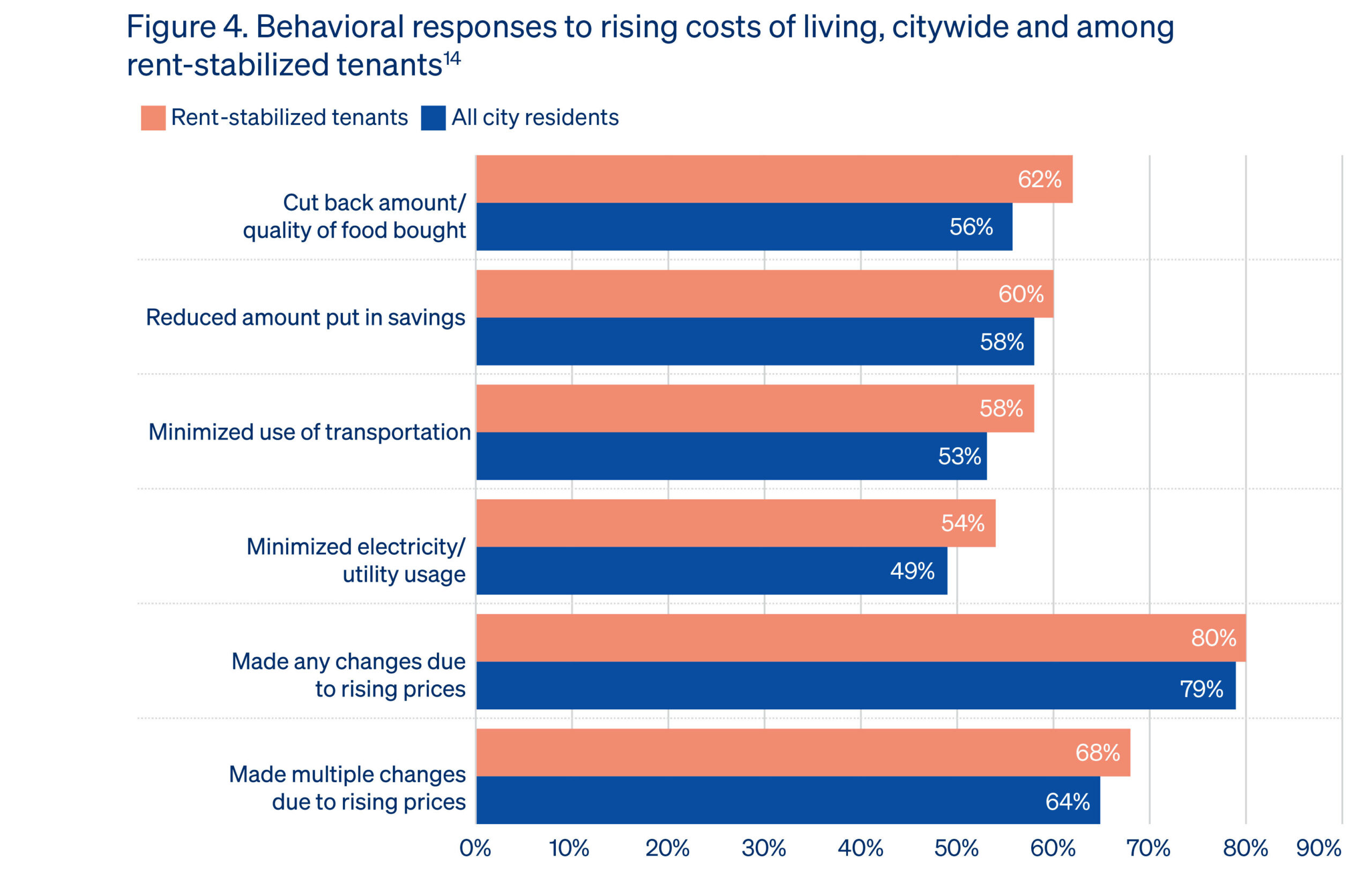
Another aspect of resource strain that has become increasingly relevant as of late is affordability. To complement our traditional measures of disadvantage, in 2024 the Poverty Tracker team developed a new set of questions designed to capture New Yorkers’ adaptations to rising costs of living, such as cutting back on savings and the quality and quantity of food purchased. 12 Figure 4 presents responses to these questions collected in 2024 and 2025. The results suggest that the vast majority of tenants in rent-stabilized units are being pressed to make lifestyle changes in response to heightened costs.
We find that 80% of rent-stabilized tenants reported making at least one change to their spending and saving patterns, with more than 2 in 3 (68%) reporting multiple adjustments. Perhaps most striking is the fact that more than half of respondents in rent-stabilized housing reported reductions in spending across every essential domain, including food purchases (62%), money in savings (60%), transportation usage (58%), and electricity/utilities usage (54%). 13 It is also worth noting that the rates of affordability challenges reported by rent-stabilized tenants were uniformly higher than the citywide averages. Affordability is, without question, a universal problem in New York City, yet these data suggest that its burden is disproportionately borne by the city’s renters in rent-stabilized housing.
Source: Poverty Tracker interim survey data from the fifth and sixth cohorts, presented at the individual tenant level. We present averages across calendar years 2024-2025. 14
Affordability concerns also extend into the realm of housing directly. As we have shown, rent stabilization provides comparatively lower-cost housing and helps keep many New Yorkers out of poverty, but that does not mean that the cost of rent is truly within most families’ budgets. One useful way to gauge housing affordability is the measure of rent burden. The 2023 New York City Housing and Vacancy Survey (HVS) defines rent burden as spending more than 30% of household income on rent and finds that 43% of renters citywide are “burdened.” 15 Poverty Tracker data confirm this troubling trend among families in rent-stabilized units. 16 17
Table 2 shows that 42% of all rent-stabilized households were rent burdened, on average, across 2022-2024. The experience of rent burden was even more common toward the bottom of the income distribution: over three-quarters (79%) of families living below the poverty line spent more than 30% of their income on rent. Low-income renters also experienced significant financial strain, with almost half (44%) of families between 100-200% of the poverty line facing rent burden. Rates dropped off substantially in the moderate- and higher-income groups.
Housing quality issues disproportionately impact low-income renters in rent-stabilized housing
In addition to the financial strains of inflation and rent burden, many rent-stabilized households must also contend with a range of housing quality issues. The 2023 HVS reports on the prevalence of different types of housing problems, including: the presence of rodents, leaks, cracks or holes in the floor or ceilings, and heating, plumbing, and mold issues. A number of these housing problems were reported by rent-stabilized households at rates double or triple those reported for market rentals. 19 Considered together, the prevalence of housing quality problems in rent-stabilized units, across the wide-ranging metrics collected by the HVS, suggests that many rent-stabilized units may not be receiving the maintenance attention that they need.
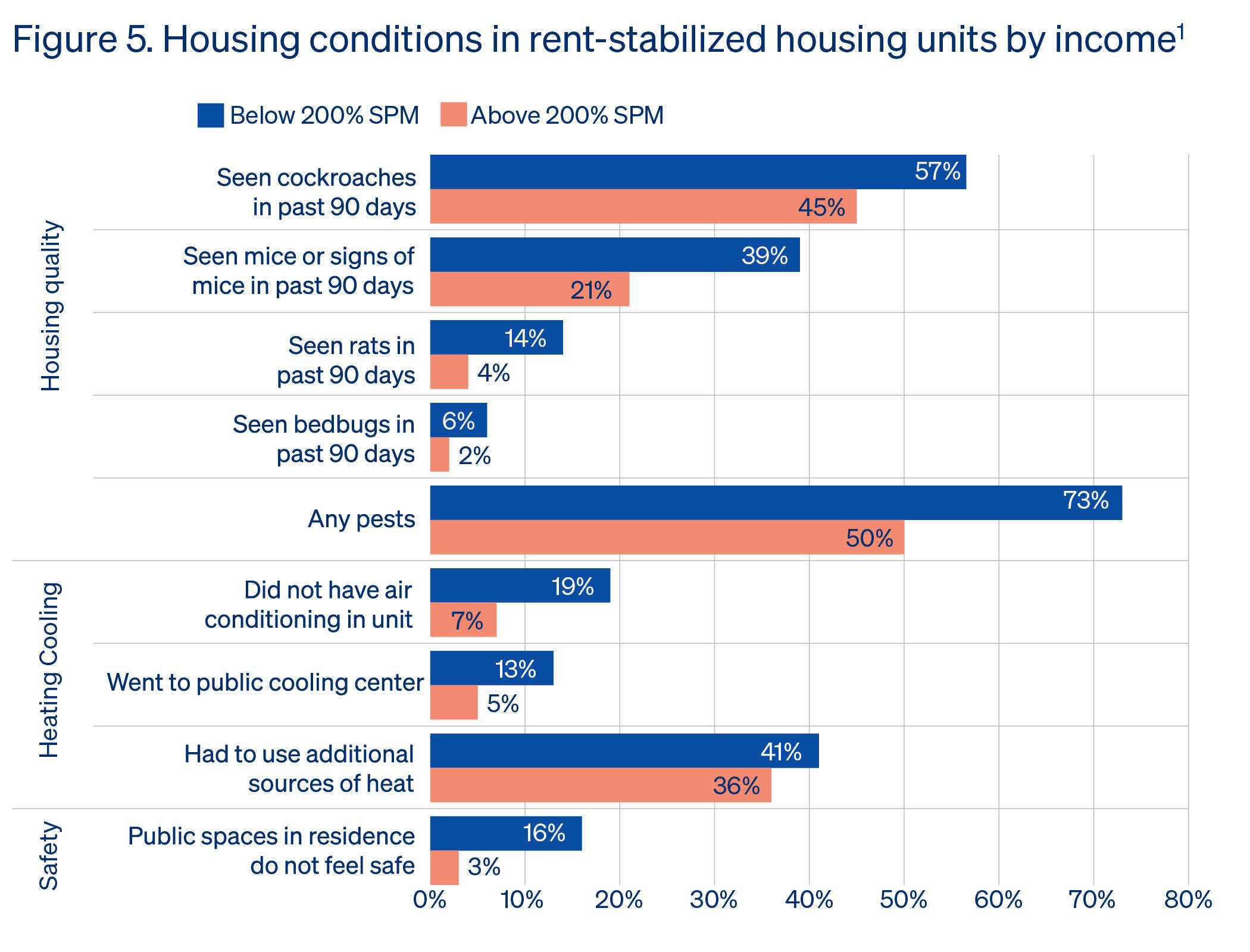
The Poverty Tracker also collects data on housing quality issues. Many of our questions align with those on the HVS, while others address additional topics such as cooling and building safety. Consistent with findings from the HVS, Poverty Tracker data on housing quality show that tenants in rent-stabilized housing experience more housing quality problems than those living in market-rate units (see Appendix Table B4). But we can also leverage our unique poverty data to examine how housing quality varies across rent-stabilized households of different income levels. The findings in Figure 5 show that lower-income households (below 200% of the poverty line) report higher rates of housing problems than moderate- and higher-income households (above 200% of the poverty line) across all domains.
In terms of housing quality issues, reports of different types of pests were substantially higher among low-income households. Low-income renters in rent-stabilized housing reported seeing mice at nearly double the rate of moderate- and higher-income renters (39% vs 21%). Approximately 3 in 5 (57%) low-income rent-stabilized households also dealt with cockroaches in their units, compared with less than half (45%) of moderate- and higher-income households.
The availability of cooling in rent-stabilized apartments was also an issue for low-income families in rent-stabilized housing, as nearly 1 in 5 (19%) reported not having an air conditioner, and more than 1 in 10 (13%) reported using public cooling centers. By contrast, only 7% of moderate- and higher-income households reported not having an air conditioner and only 5% used public cooling centers. Relatedly, 41% of low-income households in rent-stabilized housing had to use additional sources of heat in the winter, a larger share than the 36% of moderate- and higher-income households that reported this issue. 20
Source: Poverty Tracker interim survey data from the fourth through sixth cohorts, presented at the family level. We present averages across calendar years 2022-2024. 21
Finally, low-income rent-stabilized households experienced more building safety concerns than their higher-income counterparts. Approximately 1 in 6 (16%) low-income families in rent-stabilized housing reported feeling that the public spaces of their residence were not safe, compared to less than 1 in 20 (3%) moderate- and higher-income households.
These trends indicate a disparity in conditions and upkeep among rent-stabilized units, leaving families with fewer resources bearing the brunt of the problems.
CONCLUSION AND POLICY RECOMMENDATIONS
The findings presented in this spotlight demonstrate that rent stabilization is a highly effective antipoverty tool, functioning to keep an average of 140,000 New York City residents out of poverty each year. Yet in its current form, the program does not fully mitigate the financial challenges facing our city’s most vulnerable renters. The majority of tenants in rent-stabilized housing units are lower-income individuals and families who have resided in the city for over a decade, many of whom are older adults, have lower educational attainment, and must cope with more work-limiting health conditions than residents of market-rate and non-rental housing. Rent-stabilized tenants also experience high levels of disadvantage and affordability challenges. Low-income and impoverished renters encountered the steepest hurdles in recent years, with various material and health-related hardships piling up on top of financial scarcity. And as rent continues to consume a burdensome share of families’ income resources, many have found themselves making cuts to other basic needs. Finally, rent-stabilized tenants are too often forced to contend with subpar housing conditions, with issues of quality, heating and cooling, and building safety piling up on top of other resource constraints.
These challenges do not exist in isolation — they are bound together in a cycle that strains both tenants and the buildings they call home. As low-income rent-stabilized households face mounting financial pressure, many fall behind on rent, generating arrears and reducing the income that building owners depend on to stay operational. At the same time, property managers are contending with rising operating costs — insurance, utilities, and maintenance — that constrained rent rolls struggle to absorb. Caught between declining revenue and increasing costs, many buildings find themselves in a deepening financial squeeze, and it is tenants who must bear the visible consequences: the pest infestations, heating failures, and safety concerns documented in this report. Addressing this dual crisis requires a two-pronged approach — policies that bolster the economic stability of rent-stabilized households alongside interventions that shore up the financial viability of the buildings they depend on.
Much work is already underway to support affordable housing preservation at the city level. The following recommendations outline a menu of policy and programmatic changes that could help keep rent-stabilized buildings and their operators financially sound, while ensuring the tenants who depend on them have the stability they need.
1. Protect low-income households who are struggling from eviction.
The findings discussed above make clear that low-income rent-stabilized tenants are already stretched thin, with more than three-quarters of families in poverty spending more than 30% of their income on rent. For these households, falling behind on rent is a very real risk. Yet more than one in three citywide eviction filings is against a tenant in an income-restricted rent-stabilized home, nearly 40,000 non-payment filings in 2024 alone. 22 Affordable housing providers are spending at least $39 million in legal fees on a process that lasts more than a year on average and most often ends not in eviction, but in a City-funded “one-shot” emergency assistance payment. 23 This is a costly and inefficient path. Instead, the City could:
- Proactively help tenants with rent arrears before they reach housing court. As referenced in the Mamdani Administration’s May 2026 Housing Plan, early intervention is a promising avenue. An effective program could improve outreach about one-shot eligibility, prioritize case processing, and add dedicated staff.
- Establish a formal eviction diversion program for affordable housing tenants in housing court. The average amount sought at filing is $4,600, but after a lengthy court process the average one-shot climbs to $10,000. Redirecting those savings could fund a citywide diversion program — estimated at $17 million — while generating potential net savings of $101 million. 24
2. Maximize building revenue to meet rising operating costs — and protect the quality and stability of rent-stabilized homes.
When rent-stabilized buildings cannot cover their operating costs, the consequences show up directly in tenants’ homes — in deferred repairs, deteriorating conditions, and the safety problems documented throughout this report, which fall hardest on the lowest-income households. Two interventions could help close the gap between what buildings take in and what they need to spend. Both draw on recommendations from the Streamlining Procedures to Expedite Equitable Development (SPEED) Task Force, an interagency body launched by Mayor Mamdani on his first day in office to identify ways to speed up and simplify the affordable housing development process.
- Fill unit vacancies faster. The SPEED Task Force’s proposed overhaul of the Housing Connect lottery — cutting median lease-up time from 210 days to under 100 — could meaningfully reduce vacancy-driven revenue loss. The Department of Housing Preservation and Development’s extension of the re-rental waiver, allowing units to be marketed outside Housing Connect on commercial platforms, is another promising step.
- Expedite homeless referrals. The SPEED Task Force’s MATCH pilot — enabling landlords and marketing agents to work directly with shelter providers — and the new STEP system to automate homeless placements across the Department of Housing Preservation and Development, the Department of Homeless Services, and the Human Resources Administration are promising models worth evaluating for broader expansion.
3. Expand access to rental assistance for low-income households.
Even when eviction is avoided, many low-income rent-stabilized households remain in chronic instability without more durable rental support. Three interventions could help extend and expand the reach of rental assistance to improve housing stability.
- Reduce barriers to CityFHEPS recertification and retention. Bureaucratic hurdles and processing delays too often put voucher holders at risk of losing assistance they depend on to stay housed. Dedicating sufficient Department of Social Services staff to timely recertification could reduce the administrative barriers that cause households to lose assistance through no fault of their own.
- Increase funding for the New York State Housing Access Voucher Program. This program provides rental assistance to households at risk of homelessness but remains critically underfunded, with the state allocating just $50 million annually against a full program ask of $250 million. Increasing funding to that level would be a meaningful first step toward better meeting demand.
- Implement and maximize the reach of expanded SCRIE and DRIE eligibility. The recently enacted state budget raised the income eligibility threshold for these rent freeze programs from $50,000 to $75,000 for the first time in over a decade, with new tenant notice requirements. Swift implementation and proactive outreach could meaningfully expand stability for elderly and disabled rent-regulated tenants.
4. Reduce operating costs — and protect the long-term viability of rent-stabilized housing.
Many rent-stabilized buildings face structural cost pressures that require direct intervention on the expense side. Insurance premiums have more than tripled since 2017, and the claim rate in affordable and rent-stabilized housing is three times higher than in market-rate housing, with 71% of claims made by tenants. 25 The Mamdani Administration’s proposed municipally-backed insurance program — aiming to cover 20,000 homes by 2027 and 100,000 by 2030 — is a welcome step. To maximize its impact, the program could be complemented by a lease rider requiring arbitration and a legislative agenda to curb the predatory practices that drive excessive claims and costs in this sector.
5. Strengthen code enforcement to improve housing conditions in rent-stabilized buildings.
The housing quality problems documented in this report reflect not only financial strain but gaps in how the city identifies and acts on building violations. The Mamdani Administration’s Block by Block plan outlines several promising steps: launching HPD’s Fix the City initiative to conduct roof-to-cellar inspections in buildings with patterns of neglect; overhauling the Housing Maintenance Code to strengthen owner transparency and enforcement, including expanding rent-impairing violations that give tenants greater leverage to compel repairs; and making greater use of the 7A Program to remove persistently negligent owners from management of distressed buildings. Prioritizing the lowest-income rent-stabilized buildings — where this report finds quality problems most concentrated — could direct these enforcement resources where they are needed most.