December 2025
Partnership Against Poverty: An Agenda for Collaboration with the Mamdani Administration
Critical priorities for Robin Hood and NYC leadership to help New Yorkers escape poverty and achieve upward economic mobility
Contributors: Robin Hood Staff
Issues Areas: Child care, Education, Health, Housing, Jobs
As New York City’s largest local poverty-fighting philanthropy, Robin Hood funds nearly 300 direct service nonprofit organizations to create pathways to opportunity, from child care to high-quality education, well-paying jobs, stable and affordable housing, food access, and more.
For more than three decades, Robin Hood has worked shoulder-to-shoulder with every mayoral administration to fight poverty and expand opportunity across our five boroughs.
Mayor-elect Mamdani will inherit both urgent challenges and proven solutions. This document presents five critical priorities where Robin Hood is well-positioned to partner with the Mamdani administration to help New Yorkers escape poverty and achieve upward economic mobility.
2
M
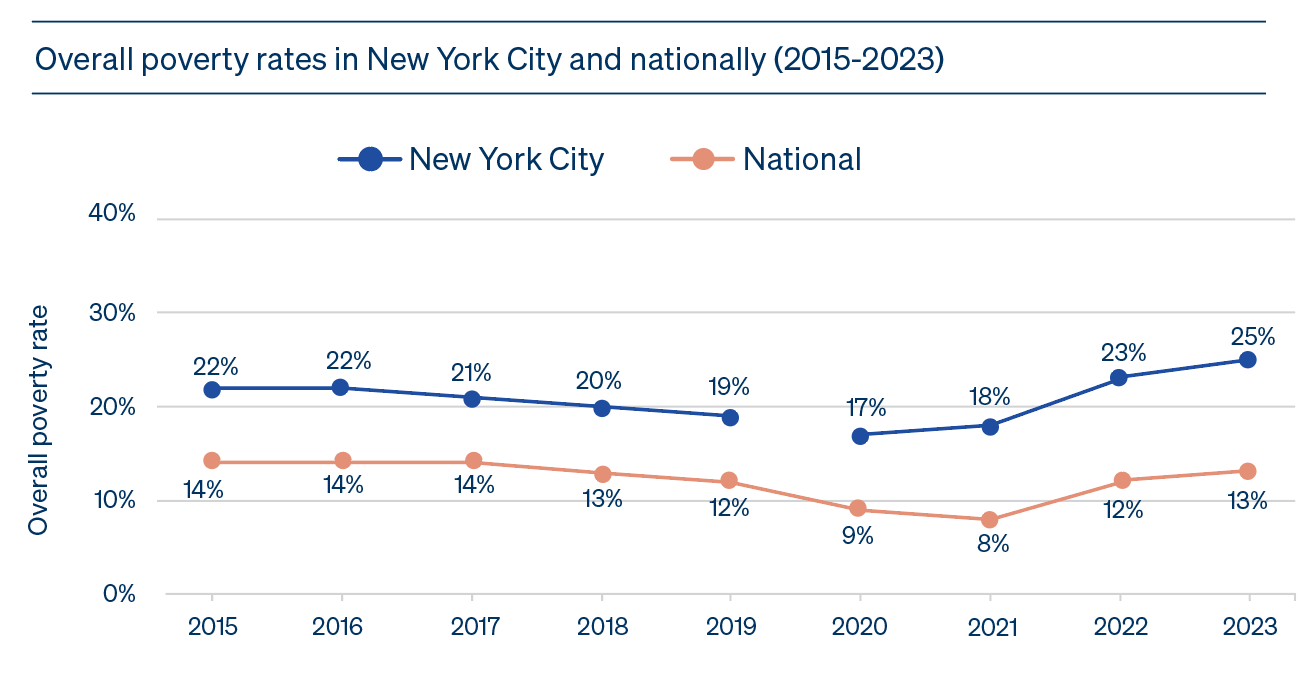
2 million New Yorkers, or one in four, lived in poverty in 2023.
100
K
More New Yorkers lived in poverty in 2023 than the year prior, an increase explained by the substantial increase in the costs of basic necessities, like food and shelter, between these years, which is reflected in the poverty line.
2
X
Asian, Black, and Latino New Yorkers were around twice as likely to live in poverty than white New Yorkers.
The Challenge
Too many New Yorkers remain locked out of opportunity. Nearly 60% of families with young children cannot find affordable child care. One-third of third graders cannot read proficiently. The vacancy rate for affordable apartments is functionally zero, at 1.4% for private sector units. Nonprofits are currently working under 102 unregistered contracts representing about $850 million of total value. These unregistered contracts are an average of 300 days late. The largest concentration is in the Department of Social Services. While this is an improvement on the backlog it remains a pressing issue for nonprofits that contract with the city. Human services workers—primarily women of color—earn 30% less than government employees in the same roles. Black unemployment has surged disproportionately, and youth unemployment stands at 13.2%, well above pre-pandemic levels.
The Opportunity
Recent investments have demonstrated what works. NYC Reads increased reading proficiency by 10.7 percentage points citywide. CityFHEPS housing vouchers helped 2,500 people move out of shelters into permanent apartments in fiscal year 2025. New apprenticeship programs in teaching and healthcare are creating career pathways while addressing critical workforce shortages. The passage of the Charter Revision Commission ballot questions on housing can pave the way to tens of thousands of new units of affordable housing. Community-based organizations, empowered to help register families for child care vouchers, have helped thousands of parents secure care for their children. Legislative reforms have begun to address payment crises threatening nonprofit providers. The incoming administration must scale these successes with urgency.