Dec 30, 2025
Tiphany’s Choice: Working to stay afloat (Bonus Episode) | This Robin Hood Moment
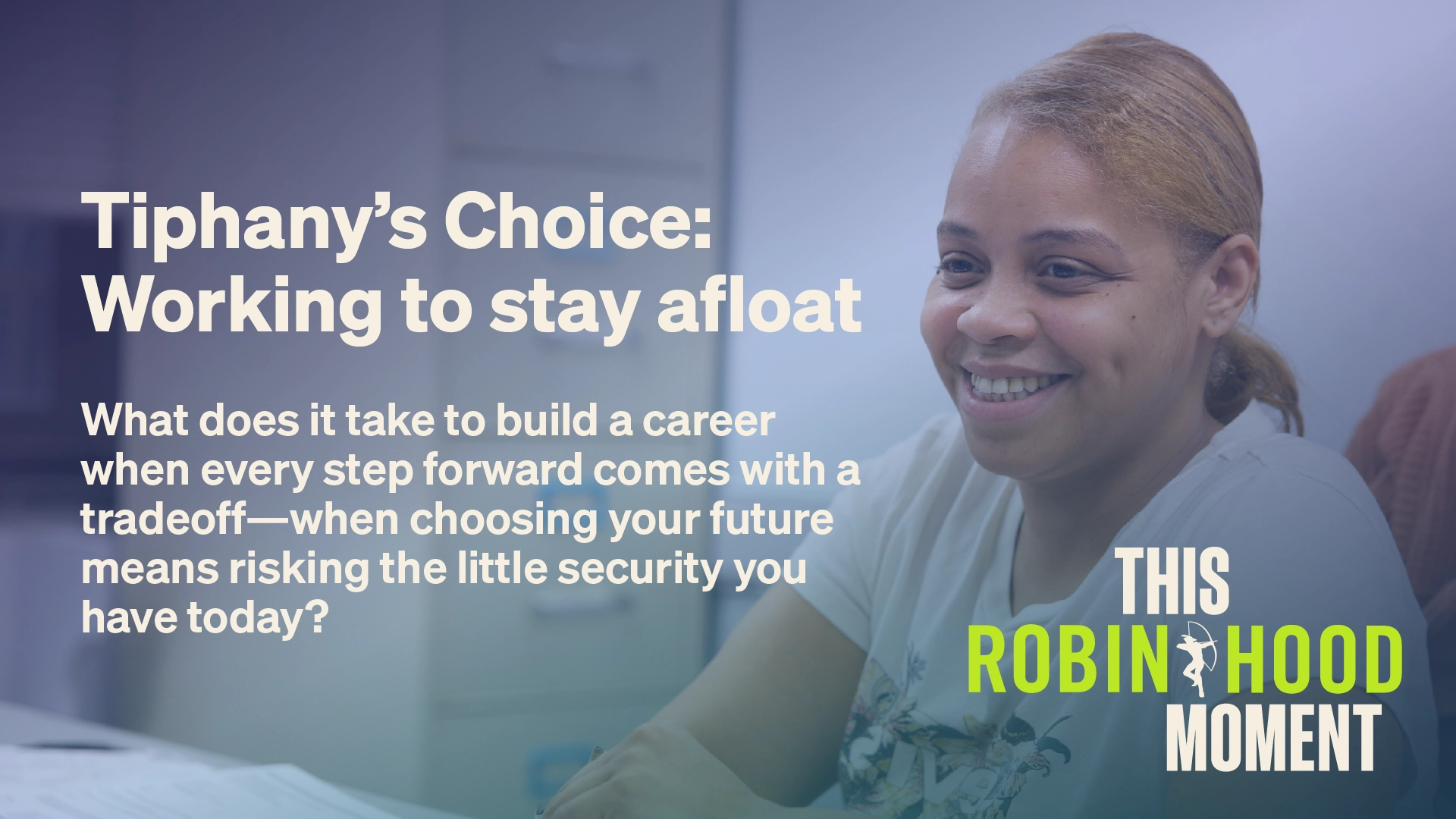
In this bonus episode of “This Robin Hood Moment,” Tiphany Malloy—a lifelong NYCHA resident and single mother—shares the hard choices behind pursuing job training while balancing childcare, long commutes, and financial risk. After discovering the NYCHA Resident Training Academy, facilitated by Brooklyn Workforce Innovations, Tiphany made a leap that changed her future and her family’s.
Listen and Subscribe: Apple Podcasts | Spotify | iHeart | YouTube
What does it take to build a career when every step forward comes with a tradeoff—when choosing training means losing wages, when choosing stability means rearranging childcare, and when choosing your future means risking the little security you have today?
For many New Yorkers, the road to stability isn’t a straight line—it’s a climb, one careful choice at a time.
In this companion to our conversation with Brooklyn Workforce Innovations’ Executive Director Aaron Shiffman, we hear from Tiphany, a lifelong NYCHA resident who turned a moment of uncertainty into a path toward purpose. After coming across a flyer in her building lobby for the NYCHA Resident Training Academy—a program facilitated by BWI—Tiphany made a choice that would transform her life.
As a single mother searching for stability, Tiphany faced the hard tradeoffs that define the cost of choice: balancing work and childcare, risking short-term income for long-term opportunity, and fighting through doubt to build something better for her family. Nearly a decade later, she’s risen from Caretaker to Property Maintenance Superintendent, overseeing the very kind of buildings she once called home.
Through Tiphany’s story, we see what happens when access meets determination—and how investing in career mobility can help New Yorkers move from surviving to leading.
Thoughts? Guest suggestions? Email us at info@robinhood.org.
“This Robin Hood Moment” is hosted by Kevin Thompson and Crystal Cooper. The show is produced and edited by Cory Winter, with graphic design by Mary Power. Additional motion graphics and footage are provided by Motion Array. Our theme music is from Epidemic Sound.
The views and opinions expressed by external podcast speakers and guests are solely their own and do not reflect the opinions of Robin Hood or its personnel, nor does Robin Hood advocate or endorse any individuals or entities featured on the episodes.
TRANSCRIPT
This transcript was prepared by a transcription service. This version may not be in its final form and may be updated.
Cory Winter: What does it take to build a career when every step forward comes with a tradeoff?
When choosing training means losing wages.
When choosing stability means rearranging child care.
And when choosing your future means risking the little security you have today.
In New York City, opportunity doesn’t usually arrive all at once.
It arrives in pieces—a shift here, a bill there, a decision you’re not sure you can afford to make.
This is “This Robin Hood Moment,” a podcast from Robin Hood.
In this bonus episode—a companion to our conversation about the cost of losing your job—we hear from someone who understands what it means to work just to stay afloat.
Tiphany is a lifelong NYCHA resident, a single mother, and now a Property Maintenance Superintendent with the New York City Housing Authority.
Her story isn’t about luck.
It’s about endurance.
About choosing forward motion—again and again—even when standing still might feel safer.
[MUSIC PLAYING]
Cory Winter: Tiphany grew up in Bedford-Stuyvesant, Brooklyn.
She moved around a lot with her adoptive mother before finally settling in Lafayette Gardens as a junior high school freshman.
Tiphany: So I grew up in Bedford-Stuyvesant, Brooklyn. I moved around a lot with my adoptive mom. Finally settling in Lafayette Gardens as a junior high school freshman. Along with five other kids in which she cared for.
Cory Winter: The community she grew up in was rough — and it left its mark.
Tiphany: The community itself was rough as far as gang members, drugs, etc., but, you know, that is what shaped me.
Cory Winter: She saw things no kid should have to see.
Tiphany: I would say I viewed, you know, a couple of people losing their life. So that definitely gave me the mindset of, like, by any means necessary, I have to elevate so that I can move out of here.
Cory Winter: That mindset — by any means necessary — didn’t come from ambition.
It came from understanding what staying put could cost.
At 22, Tiphany became a mother.
And from the moment her daughter was born, her life began to orbit around a single promise.
Tiphany: Yes. I have one daughter. She’s 22. So she’s a straight-A student at John Jay. Taking up criminal justice.
I’m very proud of her.
Cory Winter: Being a single mother shaped every decision that followed.
Tiphany: Being a single mom, and I kinda, like, dedicated my life to ensuring that she doesn’t have to go through the things that I went through.
Cory Winter: That commitment wasn’t abstract.
It was intentional.
Tiphany: I vowed, right after I gave birth, February 15th, 2003, that I would excel at motherhood. It was something that I had to do.
Cory Winter: That vow became the lens through which every choice was made.
Before training.
Before NYCHA.
Before stability—
Tiphany was working jobs that offered no future.
Tiphany: Before I seen the flyer, I had a home, right? But I was working in dead-end jobs. Jobs that I wouldn’t grow a pension with. I didn’t have health care with.
Cory Winter: Then one day, something unexpected caught her eye.
Tiphany: So, I’m taking out the garbage, and I come back in, and it’s like this bright green poster: ‘NYCHA Hiring Residents.’
I stopped. I’m like… at first, I couldn’t believe what I seen.
Cory Winter: She stood there, staring at it.
Tiphany: They hiring residents? And, oh, they got a program that they’ll teach you the confidence, they’ll teach you the hands-on skills.
And I said, this is something I could do. I can do this.
Cory Winter: That flyer wasn’t a guarantee.
It wasn’t even a job offer.
It was an entry point.
What Tiphany was looking at was the NYCHA Resident Training Academy — a program created to connect public housing residents to careers within the New York City Housing Authority itself.
The idea is simple, but rare:
If you live in public housing, you already understand what it takes to keep these buildings running. With the right training and support, that lived experience can become a career — not just a job, but one with union protections, health care, a pension, and room to advance.
Brooklyn Workforce Innovations helps facilitate that work — providing training and confidence-building so residents aren’t just placed into positions, but prepared to grow.
And Robin Hood helped launch and support the Academy across its training tracks, investing in a model that treats housing residents not as recipients of services, but as future leaders.
For thousands of New Yorkers, the Academy has been a bridge — from unstable, low-wage work to careers with security.
For Tiphany, it was something else entirely.
It was a decision.
[MUSIC PLAYING]
Cory Winter: Enrolling meant risk.
Training didn’t replace Tiphany’s responsibilities—it stacked on top of them.
Tiphany: The choices that I had to make weren’t necessarily hard. But I knew I had to make the correct choices.
Cory Winter: Correct didn’t mean easy.
Tiphany: Do I pay my cellphone bill so my daughter can reach me in the case of an emergency? Or do I buy that two-week MetroCard so that I could make it to training?
Or like sacrificing quality time with my daughter—homework help after school—or do I stay an extra 30 minutes in training to make sure that I absorb all the skills necessary?
Cory Winter: Then there was the commute.
Tiphany: I lived in Staten Island and my training was in Brooklyn.
The commute, about an hour and a half. One way.
But I never missed a day. Never.
Cory Winter: This is the cost of choice—not one decision, but hundreds.
Tiphany: It was me that she was dependent on. It was me who had to ensure her future.
Cory Winter: Training didn’t just give Tiphany new skills.
It changed how she saw herself.
Tiphany: I wasn’t very confident. I was the student at the back of the class hoping and praying that the teacher didn’t call on me.
And by the time I was finishing the program, I was in the front.
Cory Winter: She began to lead—and then she kept moving.
Tiphany: I started as a Caretaker J.
Caretaker I. ****
HPT—Heat and Plant Technician.
I learned skills that most women would think, you know, male-dominated field, but you can do it.
I took the assistant superintendent exam, aced it.
I took the superintendent exam, aced it. And now I’m here.
Cory Winter: That upward movement—from cleaning buildings to running one—is exactly what the NYCHA Resident Training Academy was designed to make possible.
Today, Tiphany oversees the kind of buildings she once lived in.
She’s responsible not just for systems and maintenance—but for people. For neighbors. For lives that look a lot like her own once did.
Tiphany: Being a superintendent, I automatically know what my residents need. I know their stories. I know their gripes. I know their frustrations—because I’ve been there.
Cory Winter: Living and working in NYCHA gives her a perspective few people have.
Tiphany: So living in NYCHA and now working with NYCHA, it kind of means to me full circle.
Being a resident, you have all of these expectations of NYCHA and what it will look like for you.
But now, being a superintendent… I know what my residents need.
Cory Winter: For Tiphany, this work is about more than a title.
It’s about stability—and what stability makes possible.
Tiphany: I believe that stable jobs and stable homes are deeply interconnected with each other.
They kind of reinforce the other one… so that you’ll be able to create that foundation for financial, physical, and mental well-being.
Cory Winter: That foundation changed everything.
Tiphany: Working for housing, I was able to have all of that. I was able to build a 401k.
I was able to open up a door to a college savings plan.
Whereas working somewhere like Popeye’s… you work really hard, but at the end you don’t end up with much.
Cory Winter: For the first time, work didn’t just cover the present—it protected the future.
Tiphany: From the very beginning, I was able to obtain all of those things that I never had before and still have a home.
Cory Winter: And still—she keeps going.
Tiphany: What’s next for me is that I am preparing… June 20th, ’26, to take the building superintendent supervisor exam.
Cory Winter: But the motivation hasn’t changed.
Tiphany: My daughter—she drives me. She drives me. She always has.
She is the one that influences me to look ahead to the next chapter, to keep learning, to keep applying for exams and positions.
Cory Winter: Because for Tiphany, this was never just about her.
Tiphany: To show her that you can do anything that you put your mind and your energy into.
No matter how long the road or how tough things may get… or even some people that will tell you you can’t do it.
Cory Winter: And when she speaks to people standing where she once stood—unsure, calculating risk, wondering if they can afford to try—she doesn’t sugarcoat it.
She tells the truth.
Tiphany: Take a chance.
No matter how you feel, if you feel like you can’t do it or it’s not worth it, or you may even think it’s too late.
Everyone has that inner strength and resilience.
Tap into that and it will lead you to success.
Cory Winter: This isn’t motivational language for her.
It’s lived experience.
Tiphany: Jump right in. Take that giant leap of faith for yourself and your family.
Always push yourself to the limits.
Hold yourself to a higher standard. Invest in yourself fully and you will be successful.
And lastly—if the help is available, take it. If the program is open, enroll.
Just believe in yourself. Believe that you can do it.
And just have that mindset that failure is not an option.
And you will make it.
[MUSIC PLAYING]
Cory Winter: Tiphany didn’t just build a career.
She built margin.
She built security.
She built a future sturdy enough to stand on — and strong enough to pass forward.
Her story reminds us that the hardest part of poverty isn’t only scarcity.
It’s the risk built into every decision.
And yet—when access meets determination, when training meets courage, when someone is able to choose the future even while staying afloat—those choices can add up to something extraordinary.
[PAUSE]
Thanks for spending time with us on this special bonus episode of This Robin Hood Moment.
If you’d like to hear the bigger picture behind Tiphany’s story, listen to the companion episode, “One Missed Shift Away from the Street.” In that conversation, our hosts Kevin Thompson and Crystal Cooper talk with Brooklyn Workforce Innovations Executive Director Aaron Shiffman about what happens when work disappears—and why access to stable careers matters so much in a city like New York.
I’m Cory Winter. My thanks to Kevin and Crystal for their editorial guidance and support in shaping this story, and to Aaron Shiffman and the team at Brooklyn Workforce Innovations for their partnership and for the work they do every day to help New Yorkers build real paths to stability.
But most of all, I want to thank Tiphany—for her honesty, her determination, and for trusting us with her story. Her choices, her perseverance, and her belief in what’s possible are at the heart of this series.
Thanks for listening, and for being part of this moment.