May 2026
Spotlight on: Child Care Hardship among NYC Parents
More than one in five New York City working parents experienced child care hardship in 2024 — cutting back on care or relying on inadequate arrangements due to cost — with single mothers, Black parents, and families living in poverty hit hardest.
Contributors: Schuyler Ross, Christopher Wimer, Sophie Collyer, Yajun Jia
Issues Areas: Early Childhood
Introduction
One of the key pillars of the 2025 mayoral campaign was child care affordability. It was an issue that came to define the race to City Hall; yet underpinning its popularity was the fact that millions of New Yorkers were struggling to make ends meet across varying domains. Surging transportation, housing, and child care costs in the wake of the pandemic had left families across the income spectrum stretched thin. 1
The Poverty Tracker, a longitudinal study of disadvantage and well-being jointly run by Robin Hood and Columbia University, is well-positioned to examine the affordability challenges facing New Yorkers today.
Prior Poverty Tracker spotlights have focused on the detriments of high transportation costs and the benefits of affordable housing programs. 2 3 Now, using a new set of questions fielded over the past year, we are able to report on child care-related hardships. 4 Our new questions were developed by Poverty Tracker Principal Investigator Christopher Wimer and ask parents if they used inadequate child care arrangements, reduced child care hours, or withdrew from child care programs altogether because of affordability challenges. Responses reveal that all three have become prevalent practices, with more than one-fifth of parents reporting at least one of them. It is important to note that these indicators of child care hardship represent acute experiences where parents are pushed to forgo care or use care they would otherwise not choose. Many more families in New York City experience child care cost burdens – defined as spending more than 7% of household income on child care — but this does not necessarily mean that they are experiencing the child care hardships newly identified in the Poverty Tracker. 5
As with other forms of disadvantage, child care hardship is not evenly distributed, with the highest rates afflicting younger parents, Black parents, and single mothers living without a spouse or partner. Nor is child care hardship experienced in isolation. It largely overlaps with experiences of poverty, material hardship, and health problems, forms of disadvantage the Poverty Tracker has been monitoring for more than a decade. Finally, it varies with experiences on the labor market, disproportionately affecting parents who were only able to work for a portion of the year.
In recent years, New York City and State have implemented a range of initiatives aimed at improving access to high quality child care and early education. These include expanding subsidy eligibility for child care assistance, increasing provider reimbursement rates, expanding 3-K and preschool programs, and most recently, advancing an ambitious vision to move toward universal child care for children age five and under.
As these initiatives continue to roll out and gain traction, we expect that they will help to mitigate the child care affordability challenges outlined in this report. Yet the widespread nature of the problem also means that more work will need to be done. We hope that the findings presented here can help to inform ongoing policy discussions on subsidy access, provider stability, workforce capacity, and the availability of care options that align with families’ work schedules and caregiving needs.
Key Findings
- In 2024, 15% of New York City parents had to stop using child care or cut back on hours of care because they could not afford it, and 14% needed to rely on a child care arrangement they felt was inadequate because of lack of affordable options.
- More than one in five (21%) New York City parents experienced at least one form of child care hardship (cutting back on care or using inadequate care) in 2024.
- Single mothers were the group of parents most likely to experience child care hardship. Child care hardship was also notably elevated among younger parents and Black parents relative to the citywide average.
- Families struggling to cope with other forms of disadvantage were most likely to experience child care hardship: 37% of parents living in poverty, 46% of parents living through severe material hardship, and 45% of parents living with a health problem experienced at least one form of child care hardship in 2024 (i.e., cut back on care or used care they found to be inadequate).
- Rates of child care hardship decline as financial resources increase, with only 7% of parents in the highest-income group (above 300% of the SPM threshold) reporting any form of hardship.
- There is a clear relationship between child care hardship and employment: 35% of parents who worked for only a portion of the year faced child care hardship, versus 19% who worked for the entire year.
About the Poverty Tracker
Launched in 2012, the Poverty Tracker surveys a representative sample of New Yorkers several times a year, providing critical information on the dynamics of poverty and other forms of disadvantage in the city. Unlike other surveys, the Poverty Tracker explores how New Yorkers experience poverty and material hardship over time, rather than in a single day, month, or year. In addition, the Poverty Tracker focuses on more than just income poverty; we also collect data on other core measures of disadvantage, such as material hardships and health problems. We use these alternative measures to understand how certain disadvantages, or multiple, overlapping disadvantages, make it harder for New Yorkers to survive. For this spotlight, findings are drawn from cross-sectional Poverty Tracker data collected from the third through sixth study cohorts in reference to calendar year 2024.
Child care hardship in NYC
Since its inception, the Poverty Tracker has collected robust information on five types of material hardship: food, housing, bills, finances, and healthcare. While these measures combine to paint a detailed picture of economic insecurity in New York City, they fail to capture the sacrifices that many families are forced to make in trying to provide child care for their children. Rising costs in recent years have made such “child care hardship” a prevalent concern. Thus, beginning in 2024, the Poverty Tracker team led by Christopher Wimer added two newly-developed questions to our annual surveys designed to capture New Yorkers’ experience of this struggle. The first question asks, “In the past 12 months, have you had to stop using a child care arrangement or cut back on child care hours because you could not afford it?” The second asks, “In the past 12 months, have you had to rely on a child care arrangement that you felt was inadequate because you had no other affordable options?” Taken together, they aim to evaluate how affordability challenges affect child care arrangements among New York City parents. The questions were asked of all respondents with at least one child under the age of 12.
In this spotlight, we present responses to these questions collected in reference to calendar year 2024. To represent the core population of parents for whom child care costs are most salient, we limit the sample to families with at least one parent who is working and between the ages of 25 and 55. Results are shown across various demographic groups and cut by other measures of economic disadvantage.
A look at the overall numbers reveals that child care hardship was prevalent among New York City parents in 2024 (Figure 1). Roughly 15% of parents experienced each form of hardship, respectively, and more than one-fifth (21%) experienced at least one form. 8% of parents had to navigate both forms of hardship together.
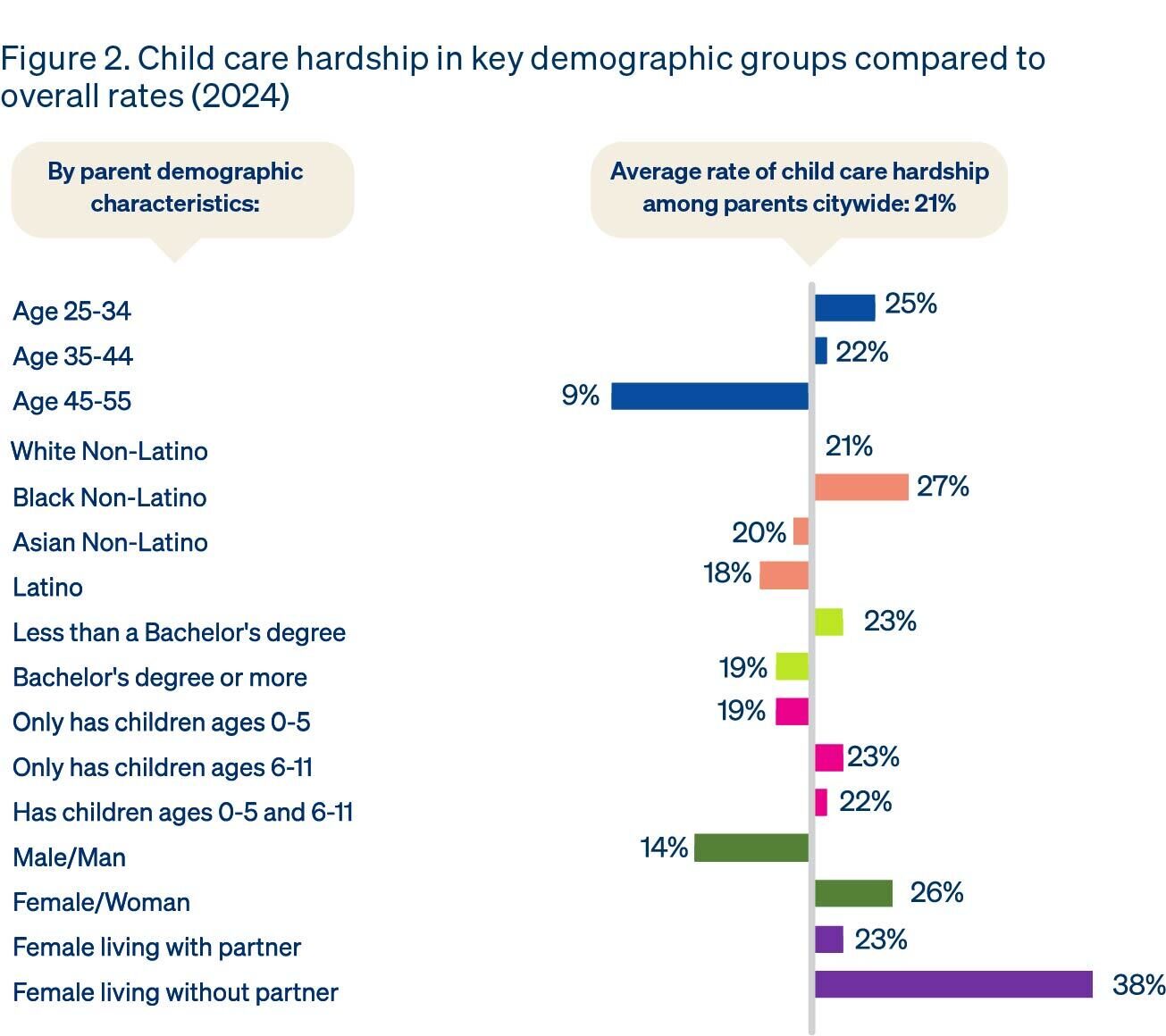
Examining the hardship rates among key demographic subgroups offers additional insights. Figure 2 plots percent difference between subgroup rates and the overall rate for the category “experienced either form of child care hardship.” 9 Young parents ages 25-34 and Black parents experienced hardship rates that were both higher than average and higher than other age and racial subgroups, respectively. Parents with different levels of educational attainment and with children in different age brackets, on the other hand, did not experience notably different hardship rates. Interestingly, female respondents were much more likely to report child care hardship than male respondents — but this may be due to reporting bias rather than a real-world pattern (e.g., fathers may be less attuned to child care needs and costs than mothers). Splitting female respondents by presence of a spouse or partner shows that family structure matters too. 10 While mothers in all arrangements were more likely to report child care hardship than fathers, single mothers living without a spouse or partner experienced higher hardship rates than any other demographic group. In fact, the rate for single mothers was 17 percentage points higher than the overall rate for New York City parents, making single mothers nearly twice as likely to report at least one form of child care hardship (38% vs 21%).
Variation in rates of child care hardship is most pronounced when looking at intersections with the Poverty Tracker’s other key measures of disadvantage: SPM poverty, material hardship, and health problems. The data in Figure 3 illustrate the compounding nature of economic struggles. Over one-third (37%) of parents living in poverty experienced at least one form of child care hardship, compared to one-sixth (16%) of parents living above the poverty line. 11 Nearly half of parents (46%) facing severe material hardship — in the domains of food, housing, bills, finances, and healthcare referenced earlier — reported facing child care hardship as well. 12 By contrast, only 11% of parents not facing any other form of severe hardship reported similar child care challenges. And 45% of parents living with a health problem encountered child care hardship in the past year, more than twice of the rate of parents without health problems (19%).
Figure 4 breaks down the relationship between child care hardship and income level further, revealing a clear link between financial resources and the prevalence of hardship. While rates of experiencing either child care hardship are highest for parents living in poverty at 37%, they remain elevated for low-income New Yorkers (between 100 and 200% of the poverty threshold) at 22%. Clearly, many families living above the poverty line still do not possess the resources needed to secure the child care they desire. There is a sharper drop off in hardship rates among moderate-income New Yorkers (between 200 and 300% of the poverty threshold) to 11%, and a further decline to just 7% for the highest-income New Yorkers (above 300% of the poverty threshold). Finally, Figure 5 depicts how child care hardship varies based on parental work status. For families with two parents, we use the work status of the parent who worked the greatest number of months in the year.
What stands out here is that hardship rates are higher among parents who worked for ten months or fewer (35%) than among parents who worked for the entire year (19%). The dynamic underlying this trend is likely two-faceted: limited access to child care may constrain parents’ ability to work consistently through the year, and this inconsistent work schedule may in turn make securing reliable child care more difficult. Either way, these findings highlight the importance of affordable, accessible child care for families experiencing volatile employment.
Conclusion
Overall, the results presented here capture an image of a city struggling to afford reliable, high-quality child care. Over one-fifth of working parents aged 25-55 reported experiencing some form of child care hardship in 2024, with even larger shares of young parents, Black parents, and single mothers being affected.
Families struggling to cope with other forms of disadvantage were hit the hardest – more than one-third of parents living in poverty and nearly half of parents experiencing severe material hardship and health problems also faced child care hardship during the year. As prices continue to rise and threats of cuts to federal child care funding loom, the outlook for parents already navigating child care affordability challenges looks precarious at best.
Fortunately, New York City has made important investments in early childhood education and child care access in recent years, which have likely prevented child care hardship rates from ballooning even higher.
But the findings in this spotlight suggest deeper structural reforms are still needed to reduce hardship and build a child care system that is affordable, stable, and responsive to the reality working families are facing. The following reforms and actions could help respond to the needs identified in the Poverty Tracker data.
- Fully fund the Child Care Assistance Program, which provides vouchers to help families afford various types of child care. The City and State should ensure that all eligible families can access child care assistance without being placed on waitlists or denied recertification due to funding shortfalls. The waitlist currently exceeds 17,000 children and has been growing by roughly 1,500 children per month since the spring of 2025.
- Remove the minimum earnings requirement for child care assistance. New York State could eliminate a regulation requiring parents to earn at least a minimum wage to qualify for child care assistance. This requirement disproportionately harms parents who work part-time, participate in the gig economy, or experience wage theft.
- Expand authorized hours for care. Current regulations require child care subsidies to match a parent’s exact work hours, creating instability for families with fluctuating schedules and making it difficult for child care providers to maintain consistent enrollment and staffing. New York State could decouple child care assistance from parents’ exact work hours and provide families with stable, flexible access to child care that reflects the realities of today’s workforce.
- Target investments toward families facing the highest levels of hardship. Given limited public resources and existing eligibility constraints, the City should continue prioritizing investments for families with the greatest barriers to accessing care, including those experiencing homelessness, receiving cash assistance, or involved in the child welfare system, while also expanding support in communities with high unmet need. Future investments could prioritize communities facing the greatest barriers to care.
- Stabilize and strengthen the child care workforce. The parents who relied on inadequate care due to lack of affordable options reflect, in part, a constrained provider landscape driven by administrative barriers that make it difficult for programs to operate sustainably. Persistent workforce shortages and low wages continue to limit care availability across the city. Investing in long-term workforce stability through improved compensation, benefits, recruitment, and retention supports for early childhood educators would help stabilize the workforce.
- Reduce administrative burdens on providers. The City and State could simplify contracting, licensing, payment, and reporting requirements for child care providers. Administrative complexity and delayed reimbursements continue to undermine provider stability and limit available options for families. Streamlining compliance systems and ensuring timely payments would allow providers to focus more resources on delivering care and maintaining staffing.