May 2026
Universal Child Care as Anti-Poverty Policy: Assessing the Potential Impacts of Universal 2-K and 3-K
Universal 2-K and 3-K could cut child poverty by nearly 9% among NYC's two- and three-year-olds, lifting 4,100 children out of poverty annually by eliminating child care costs and enabling parents to re-enter the workforce.
Contributors: Ryan Vinh, Danielle Wilson, Christopher Wimer, Sophie Collyer
Issues Areas: Early Childhood
Introduction
The acutely high cost of child care, especially in cities with already elevated living costs, is a known burden for families. In New York City, families with young children are hit especially hard by these costs: average child care costs in the city for families with infants and toddlers in family-based care were nearly $20,000 annually 1 in 2024, with even higher average costs for center-based care. Our recent research has also shown that 21% of parents in New York City experienced some form of child care hardship in recent years, which forced them to forgo or use inadequate care. 2 However, it is not just the cost of child care that is burdensome for families: high costs can also force parents to leave the labor force to care for their children, forgoing much-needed income. Indeed, the combined effect of child care costs and lost income can increase economic precarity and potentially push these families into poverty.
In response to these concerns and the larger crisis of affordability in New York City, Governor Kathy Hochul and Mayor Zohran Mamdani have pledged to make universal child care available in the city over the coming years, starting with extending care to younger children. The rollout of universal child care will occur in stages, with the administration planning to add 2,000 child care seats for two-year-olds in the fall of 2026 and 12,000 in the following year. Simultaneously, the administration is also working to ensure the 3-K program is truly universal. 3 These reforms have the potential to reduce child care costs and lift families out of poverty in New York City, but the magnitude of these potential impacts is yet to be fully understood. To that end, this brief aims to answer the following questions: How many two- and three-year-olds in New York City are pushed into poverty by family child care expenses? What would poverty among these young children have looked like in recent years had families had access to universal free child care? And how do the impacts of universal child care on poverty compare to the impacts of other large anti-poverty programs? Our estimates account for both the reduced cost of child care to families, as well as the increase in parents’ labor force participation that could result from these expansions.
In particular, we estimate poverty among two- and three-year-olds under four scenarios for the 2-K and 3-K programs:
- The 2-K program at 50% coverage and the 3-K program at current coverage
- The 2-K program at 75% coverage and the 3-K program at current coverage
- The 2-K program at 100% coverage and the 3-K program at current coverage
- The 2-K program at 100% coverage and the 3-K program at 100% coverage
Key Findings
- Between 2022 and 2024, an average of 3,400 two- and three-year-olds in New York City were pushed into poverty each year by the cost of child care.
- If universal 2-K and 3-K had been in place between 2022 and 2024 at full coverage, it could have cut poverty among two- and three-year-olds by roughly 9%, lifting 4,100 of these young children out of poverty in each year and fully offsetting the impact of child care costs on poverty among this age group.
- The impacts of universal 2-K and 3-K on poverty among two- and three-year-olds have the potential to be larger than the impacts of WIC and to approach the anti-poverty impacts of SNAP among two- and three-year-olds.
Approach
The high costs of child care, especially for younger children, leaves families with less money to pay for other essential goods and services and pushes some to forgo earnings entirely in order to provide care for their own children. As a result, there are two pathways through which universal child care can reduce the risk of poverty: it can (1) reduce the child care costs that may push families into poverty, and (2) increase family income if parents enter the labor force or increase their hours when care is available. While child care has the potential to produce wide-reaching, long-run impacts on children’s outcomes 4 — both in childhood and adulthood — this brief is focused on understanding its more immediate impacts on their risk of living in poverty.
Our methodology is described in greater detail in the Appendix, but to summarize, our estimates examine the impact of 2-K and 3-K expansions on poverty among two- and three-year-olds in New York City measured using the Supplemental Poverty Measure (SPM). Importantly, the SPM subtracts child care costs from family resources, which are then used to determine whether families are living above or below the poverty threshold. As such, child care expenses, under the SPM, can move children and families into poverty. 5 (See below highlighted text for additional information on how these expenses are accounted for in the SPM.)
As noted, child care expansions can also increase parents’ labor force participation, raising their families’ resources in turn. In our models examining the impact of 2-K and 3-K expansions on poverty, we account for both the impact of these policies on families’ child care expenses and their income from work. 6
How is spending on child care accounted for in the Supplemental Poverty Measure?
The SPM treats work-related expenses as necessary costs that reduce the resources families have available to meet their needs. These expenses include costs incurred to get to work, such as commuting expenses, and costs incurred in order to work, such as child care expenses. The SPM deducts these expenses when determining the resources families have available.
However, the SPM limits the amount of child care expenses that can be deducted from family resources. For single-parent families, deductible child care expenses are limited to the parent’s earnings. For example, if a single parent had $20,000 in earnings, the maximum amount of child care expenses that could be deducted from their resources is $20,000. For married-couple families, they are limited to the earnings of the lower-earning spouse. This limit is intended to ensure that poverty status reflects the child care costs needed to work, rather than differences in families’ preferences or choices about how much to spend on care.
It is also important to note that, in our models, “universal child care” is assumed to absorb all child care costs associated with work. Such a program would ensure that parents have access to child care regardless of their work schedules, and that care would not be limited to school hours or standard work hours. We also assume full uptake of care for those whom our models assign to a 2-K or 3-K seat. Note that in the initial two scenarios, we are assuming that there are only 2-K seats available for 50% and 75% of two-year-olds in the city, respectively. Together, these assumptions mean that our estimates should be interpreted as upper-bound estimates of the potential impacts of the 2-K and 3-K expansions we model.
RESULTS
How many two- and three-year-olds in New York City are pushed into poverty by family child care expenses?
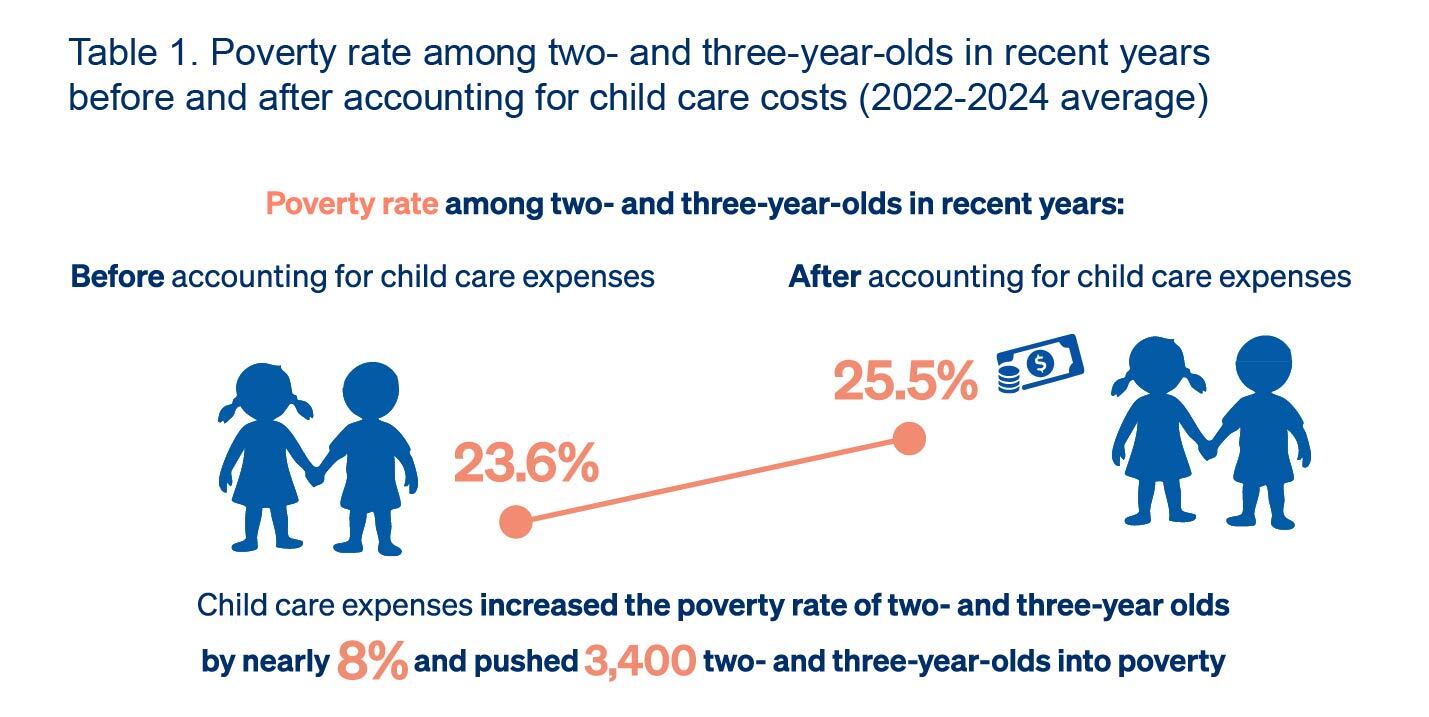
As discussed, child care expenses can push families and children into poverty, and in Table 1, we show the impact that these expenses have been having on the annual poverty rate of two- and three-year-olds in New York City in recent years (2022–2024). Before accounting for these expenses, 23.6% of two- and three-year-olds in the city were living below the poverty line. Once accounting for child care spending, however, the poverty rate rises to 25.5%. This means that, in recent years, child care expenses have increased the poverty rate of two- and three-year-olds in the city by 8% and pushed 3,400 two- and three-year-olds into poverty each year. 7

What would poverty among these young children have looked like in recent years had families had access to universal child care?
In Table 2, we examine what the poverty rate of two- and three-year-olds could have been in recent years had different 2-K and 3-K expansions been in place. The top row shows the baseline poverty rate after accounting for child care spending (25.5%) and each subsequent row shows the poverty rate with a different level of expansion to 2-K, or, in the case of the last row, both 2-K and 3-K. The table also shows the percentage point reduction and percent reduction in the poverty rate associated with each of the expansions, as well as the number of children moved out of poverty with each expansion. Note that, like estimates from any model, each estimate in Table 2 is centered within a confidence interval specifying a range of plausible impacts. In appendix Table C1, we present these confidence intervals alongside the main estimates in Table 2.
The final row of Table 2 shows that, had universal 2-K and 3-K been available and fully utilized in recent years, the policy could have cut child poverty by roughly 9% among two- and three-year-olds — fully offsetting the increase in poverty associated with child care expenses for this age group. Note that more two- and three-year-olds would have been moved out of poverty by universal 2-K and 3-K (4,100) than were pushed into poverty by child care expenses (3,400) because of the impact that 2-K and 3-K has on parents’ labor force participation. Thus children are not only moved out of poverty because their family is spending less on care, but also because of increased family income from work. The impacts are more muted with more modest expansions to 2-K, as well as with universal 2-K at 100% coverage but without universal 3-K at 100% coverage. Of course, when looking only at the poverty rates of two-year-olds, the impacts of the 2-K expansions are greater than when looking at the combined impacts on two- and three-year-olds (see Appendix Table C2).
While Table 2 highlights the number of two- and three-year-olds moved out of poverty by 2-K and 3-K expansions, these policies could also move the parents of these children and their other siblings out of poverty. In Table 3, we show the total number of New Yorkers who could be moved out of poverty under each of the above scenarios.
How do the impacts of universal child care compare to the impacts of other large anti-poverty programs?
A natural question that emerges from the results in Table 2 is, how do these impacts compare to those associated with other large programs known to reduce poverty among children? In Figure 1, we show the number of two- and three-year-olds moved out of poverty in recent years by two large nutrition-based programs — the Supplemental Nutrition Assistance Program (SNAP) and the Special Supplemental Nutrition Program for Women, Infants, and Children (WIC) — as well as the universal 2-K and 3-K program with 100% coverage. Based on our estimates, the universal 2-K and 3-K programs with 100% coverage would move more two- and three-year-olds out of poverty (4,100 children) than WIC (1,200 children) and have impacts that are close to those associated with SNAP (6,200 children).
CONCLUSION
The high costs of child care in New York City have been a persistent problem for families, particularly those with young children. In response, Governor Kathy Hochul and Mayor Zohran Mamdani have pushed universal child care to the top of the agenda for the city, aiming to institute universal free care in the coming years. The expansion will be rolled out over time, beginning with 2,000 child care seats for two-year-olds in the fall of 2026 and 12,000 in the following year, at the same time as the 3-K program is made truly universal.
Beyond reducing financial strain, universal free child care in the city could also have a meaningful impact on the child poverty rate, particularly among families with young children for whom the costs of care are greatest. In this brief, we examine how 2-K and 3-K expansions could impact the poverty rate among New York City two- and three-year-olds. Using the latest data available, we find that 3,400 of these young children are pushed into poverty each year because of child care costs. Universal 2-K and 3-K could fully offset the impact of child care expenses on the poverty rate of two- and three-year-olds, and in recent years, 4,100 fewer two- and three-year-olds could have been in poverty in each year had these policies been in place. Comparing these impacts to other programs like WIC and SNAP show that the anti-poverty impacts of 2-K and 3-K are similar to these other large anti-poverty programs. These findings suggest that universal 2-K and 3-K could not only be important vehicles for addressing the high cost of child care in the city, but also the high rate of child poverty.