Dec 16, 2025
One Missed Shift Away from the Street: The cost of losing your job | This Robin Hood Moment
In New York City, work is supposed to mean stability. But for too many New Yorkers, it doesn’t. One missed shift can trigger a cascade of consequences—missed rent, mounting debt, even homelessness. In this episode of "This Robin Hood Moment," we examine what happens when people fall through the safety net—and what it takes to help them find their footing again.
Listen and Subscribe: Apple Podcasts | Spotify | iHeart | YouTube
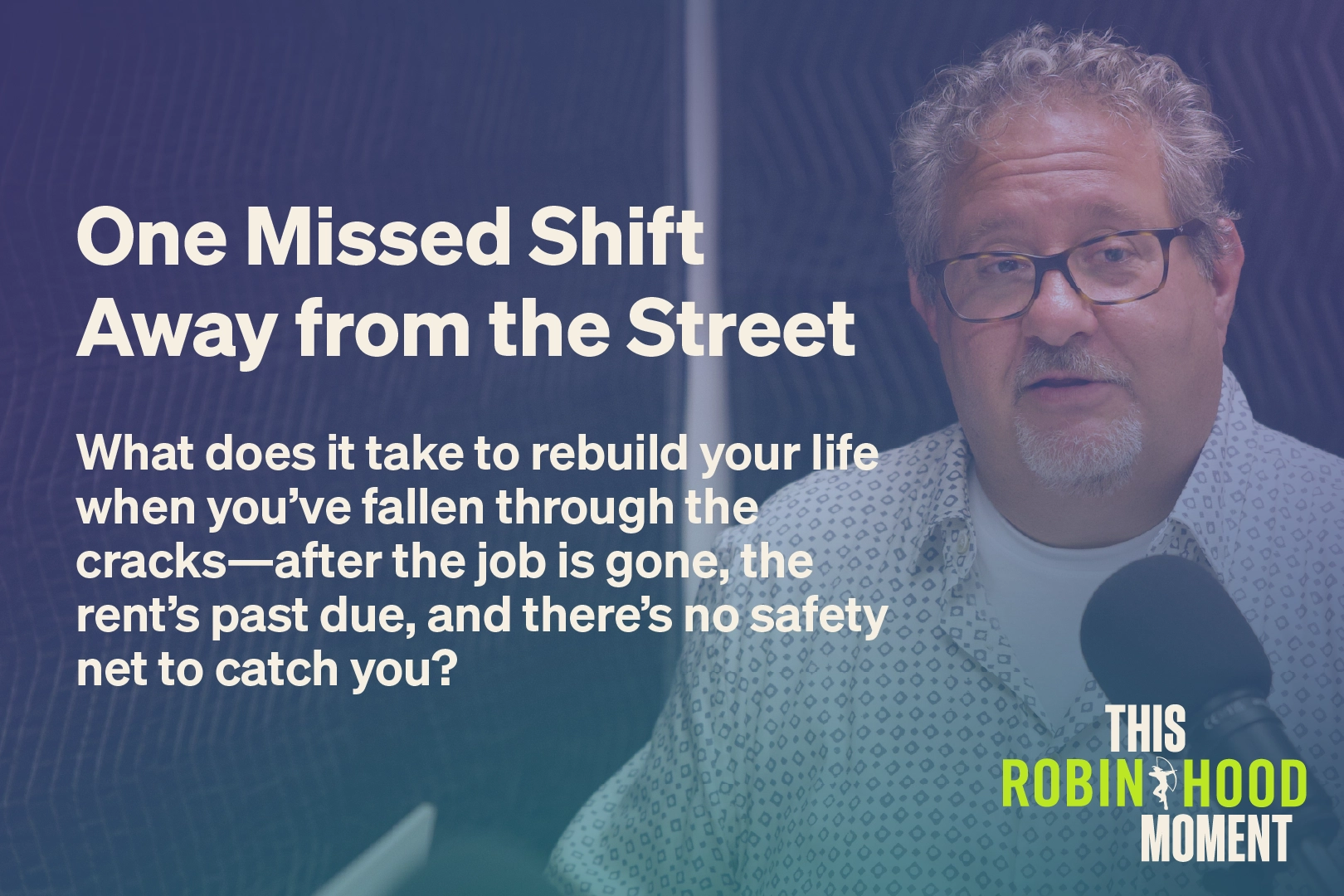
What does it take to rebuild your life when you’ve fallen through the cracks—after the job is gone, the rent’s past due, and there’s no safety net to catch you?
In New York City, the margin for error is razor thin—especially for low-income workers. One missed paycheck can mean eviction. One illness can mean job loss. One childcare emergency can unravel a household. For many New Yorkers, there is no cushion. There is no safety net. There is only the cost of choice: working while sick, delaying care, or turning down opportunity because stability is always on the line.
In this episode, we explore how workforce development can serve as a bridge—not just to employment, but to restored stability—after someone has already fallen through the cracks. Our guest is Aaron Shiffman, Executive Director of Brooklyn Workforce Innovations (BWI), a nonprofit that has spent over 25 years helping New Yorkers build in-demand skills and launch careers in industries like transportation, media production, woodworking, and construction. For BWI, training isn’t the finish line—it’s the starting point of long-term support and upward mobility.
Together, we examine what it takes to help someone rebuild after crisis, how BWI navigates the gaps in public systems, and why meaningful employment remains one of the most powerful tools to fight poverty in New York City.
Thoughts? Guest suggestions? Email us at info@robinhood.org.
“This Robin Hood Moment” is hosted by Kevin Thompson and Crystal Cooper. The show is produced and edited by Cory Winter, with graphic design by Mary Power. Additional motion graphics and footage are provided by Motion Array. Our theme music is from Epidemic Sound.
The views and opinions expressed by external podcast speakers and guests are solely their own and do not reflect the opinions of Robin Hood or its personnel, nor does Robin Hood advocate or endorse any individuals or entities featured on the episodes.
TRANSCRIPT
This transcript was prepared by a transcription service. This version may not be in its final form and may be updated.
Kevin Thompson: From Robin Hood—New York City’s largest poverty-fighting philanthropy—I’m Kevin Thompson. Welcome to “This Robin Hood Moment.”
[MUSIC PLAYING]
Kevin Thompson: What does it mean to be one missed shift away from the street?
For far too many New Yorkers, stability hangs by a thread. You can be working full time, showing up every day, doing all the right things—and still be one unexpected illness, one childcare disruption, one transit delay, or one canceled shift away from losing your paycheck. And from there, the consequences can cascade. Missed rent. Missed bills. Missed opportunities. It’s a cruel domino effect. And for people living in or near poverty, the margin for error is razor thin.
This episode is part of our larger discussion around the Cost of Choice—where we explore the impossible decisions poverty forces people to make. And today, we’re asking: What happens when there is no safety net to catch you, and work itself doesn’t provide the cushion you need?
We often talk about workforce development in terms of skills and employment rates. But today, we’re digging into how workforce development can be a lifeline. Not just to a paycheck, but to long-term stability and economic mobility—especially when someone has already fallen through the cracks.
My co-host—the ever insightful Crystal Cooper—and I will be meeting someone who’s been helping people find that lifeline for more than two decades. Aaron Shiffman is the Executive Director of Brooklyn Workforce Innovations, a Robin Hood grantee that connects thousands of low-income New Yorkers to high-quality, career-track jobs in industries like construction, transportation, media production, and more. His work isn’t just about employment—it’s about building opportunity and dignity for New Yorkers who’ve been locked out of the economy.
But before we get underway, if you have any guest suggestions or thoughts about this episode, be sure to get ahold of me at info@robinhood.org.
[MUSIC PLAYING]
Kevin Thompson: Crystal, I keep thinking about how often we assume that “getting a job” is the fix for poverty—but the truth is, for a lot of people, having a job isn’t enough. Not when it doesn’t come with security, benefits, or a real pathway out.
Crystal Cooper: Absolutely. And not when that job is gig-based, temp-based, or offers zero flexibility for the very real chaos life throws your way—especially when you’re living on the edge. I think what Aaron’s work reminds us is that stability has to come first before growth is even possible.
Kevin Thompson: Exactly. And what struck me in our prep for this episode is how intentional BWI is in designing programs that meet people where they are—with short-term training, wraparound support, and long-term follow-up. They’re not just getting people into jobs. They’re walking with them as they rebuild.
Crystal Cooper: And that rebuilding is so personal. It’s emotional. It’s about self-worth, yes—but it’s also about systems that have failed to support people. I’m excited for folks to hear Aaron talk about how we can reimagine those systems—from workforce development to housing to safety nets that truly catch people.
Kevin Thompson: Let’s get into it. Aaron, welcome to the show!
Aaron Shiffman: Thanks for having me.
Kevin Thompson: Aaron, I want to start with the human reality behind this episode for so many New Yorkers. They’re just one missed shift away from being on the street. Aaron, you’ve said before that for anyone to flourish, their basic needs must be met to be ready to work. When you said that, what did it bring up for you in your work with Brooklyn Workforce Innovations? And what are some of the most common barriers your clients face before they even walk through the door?
Aaron Shiffman: For me, this hits home. So many New Yorkers, employed and unemployed, are one emergency away from impossible choices paying for groceries or paying the utility bill, paying for rent, or seeking medical care. I BWI we see this every day. Of the 900 low income New Yorkers we train each year. Most are rent burdened, food insecure, or both. Many are receiving public assistance and Medicaid.
That knowledge shapes both our mission and our program models. Our trainings are short, 5 to 8 weeks long, though full time, so people can get to work quickly after training. But our commitment to graduates extends for two years as graduates navigate their new careers. We also support people through emergencies and transitions because no, life doesn’t stop once someone enrolls in training or gets their first job or gets their first job in a long while.
Over a decade ago, our board of directors created the tools of the Trade Fund, a small but powerful resource to cover the hidden costs of going back to work Metro cards before their first paycheck hits the bank. Childcare, emergency childcare during training, or the tools or gears they need for their very first day on the job. This funding is part of what makes BWI special.
We don’t just train people. We stand with them as neighbors, empowering them to take the next step, even when the ground feels shaky beneath their feet.
Crystal Cooper: I want to just zero in on that. So we know that BWI catches people sometimes after they’ve already fallen through that safety net. What are some circumstances that potential clients are dealing with as they come to you? You know, sometimes they have a job. Sometimes they don’t or their job doesn’t pay enough to cover the the bills and their expenses of life or their childcare.
Can you just describe some situations that might paint a very real picture for our listeners of what those New Yorkers, challenges are?
Aaron Shiffman: So success at BWI or any training and placement program requires at least a baseline of stability, a place to live, and just financial support to get through training and a job search, and for parents reliable childcare. BWI serves New Yorkers who faced multiple persistent barriers to employment, low levels of formal education, uneven work histories often with long gaps, and unemployment.
And behind those statistics is very human reality. A stressful letter from a landlord warning of a rent arrears and the threat of eviction. Constant worry about providing enough food for themselves or their families, the daily struggle to secure quality, affordable childcare, and the responsibility of caring for family members while trying to train or work. That’s why we design our programs not only around skills and intimate credentials, but around respect.
Respect for each person’s time, their dignity, and the many responsibilities they’re juggling. Being unemployed doesn’t mean someone’s time is any less valuable. More often than not, our trainees are parents and caregivers, balancing extraordinary pressures while striving for something better.
Crystal Cooper: When you are kind of assessing and adjusting in real time, are you looking at creating pipelines into different industries or adjusting to where the jobs and the pay is? Are you adjusting the training programs themselves or the outreach? Like what does that sort of look like?
Aaron Shiffman: I mean, honestly, all of the above, over the last two and a half decades, we’ve we’ve had situations where we have to do each. I think we’re always looking to make sure that curriculum is relevant, that we’re training people for the the skills and and the opportunities that are available to them on day one. But we’re also looking downstream a little bit and making sure that the opportunities, the early career roles that we’re finding for people are ones that could build and help them advance themselves.
But we always have to look at new markets, make sure we’re attracting the talent and the untapped talent for the roles that are available. I think we’re always looking for where the good jobs are. It doesn’t happen in a vacuum and it’s tough to build out a new vertical. We need to know that there are jobs there and there are opportunities to hire a service population like ours that might be more vulnerable than applicants that are coming straight in from indeed or other sources.
But we’re always looking and keeping our eyes open. The worst thing we could do is train folks for jobs that don’t exist. So we have to make sure that the programs that we do have are truly making a difference for people’s lives. And upon graduation, we have as quick a workforce attachment to roles that we possibly can.
Kevin Thompson: Wow. That’s amazing, because that versatility really does give you the ability to meet people where they are and meet the market where it is.
Aaron Shiffman: I mean, I’ll be honest, we could only do it if we have flexible dollars, right? So the more restrictive funding is to workforce development organization, they’re going to pay for X, Y and Z. You have to do and execute x, y and z. But the holy grail in our work is the general operating support. And it’s sort of, it’s trust based philanthropy in a lot of ways.
Before we started calling it trust based philanthropy, you’re supporting an organization, allowing them to be nimble, research pivot and make course corrections as they see fit, holding true to their mission and to their populations that they serve.
Crystal Cooper Absolutely. And if funders like we are focused on outcomes, we have to give you the flexibility to to do that.
Aaron Shiffman: I think that’s right. In workforce development you have to be focused on outcomes. You know, there’s a lot of poverty prevention work that that doesn’t really show up well on the back of a a baseball card or a dashboard workforce development actually does. You can measure and track where people were before trading, where they are after training. Are they still working?
What’s the wage advancement? In large part because Robinhood was looking at a 25 years ago. BWR has been looking at it, but the impact that we’re making really can be documented by looking at the wages and the career advancement and the job retention that our graduates are able to secure.
Kevin Thompson: And one of the biggest cost of poverty is the cost of time. You know, when a missed day of training or work means that you miss your pay, or you miss rent, or you miss opportunities? How does BWI structure programs to lower that cost?
Aaron Shiffman: For people living within or on the edge of poverty, every hour of every day matters. That’s why BWI designs programs that honor the time and effort our applicants put in, and we attempt to remove barriers that can slow their progress. We do our best to put ourselves in the shoes of people applying to or participating in our training programs, and we do everything we can to make sure that our processes reflect our values and the respect we have for the people who go through our programs.
Over the past 18 months, for example, we partnered with a research organization called MDC to reexamine our applicant journey. We found that motivated candidates were sometimes stalled by unclear instructions or too much information thrust upon them all at once. So we simplified the process with clear, step by step guidance, and carefully we developed a sequence or a cadence of follow up emails and texts.
The impact was immediate and impressive. Applicants moved from information session to application. Nearly four times faster, and more people advanced towards enrollment. These subtle process adjustments proved what we’ve always believed. When we respect people’s time and we reduce structural friction. You create conditions for them to succeed.
Crystal Cooper: That kind of brings me back to, you know, where we started the conversation in terms of the situations that people find themselves in when they enter your door or open the web browser. Can you just explain sort of what meeting people where they are looks like? And, and, you know, whether it’s their lived experience of where they are or, or how they actually come to you, just, you know, what is what is that journey through that funnel look like for someone who’s struggling.
Aaron Shiffman: For someone who’s struggling and interested in our program, there is a variety of ways that they might hear about us. So we do some direct community recruitment. We get a lot of referrals from community partners. We’re out there meeting with the industry partners that people ultimately get a job at, but they may get an applicant who’s not appropriate, but they seem motivated and want to be a good neighbor.
They may refer that individual to us. We have a long, track record of success in some of our programs. And quite honestly, word of mouth from our alumni is our single greatest, referral source so they could find us. But what it means to meet them where they’re at is really about building training programs that don’t have high barriers to entry.
So we really want to create a program where as many New Yorkers from a variety of skill sets, a variety of backgrounds, and a variety of communities are able to access the opportunity. So you don’t for most of our programs, you don’t need a high school diploma, right? For some of them, you might need to be reading at a certain at a certain literacy level to be able to absorb the content that’s delivered relatively quickly in that bootcamp style training.
But we’re not creating artificial barriers to the program, so we want to do it. We want to keep it short. We want to make sure that the the content is can be delivered in a way that’s, going to be comfortable for the 55 year old individual that might have spent 20 years incarcerated, as it is for the 19 year old kid who just got, you know, just got out of school or just got their their equivalency diploma.
Kevin Thompson: Yeah. Because you’re really addressing needs from a lot of niche populations. Like, I understand you all have a NYCHA residency training academy, is that correct?
Aaron Shiffman: That’s correct.
Kevin Thompson: Yeah. Talk to us a little bit about, you know, the intersection of workforce pathways between, you know, housing policy in general and poverty reduction, particularly with, with the NYCHA group that you’re working with.
Aaron Shiffman: Sure. It’s no mystery that, or secret that jobs and housing are closely tied together, and especially here in New York City. The NYCHA resident training camp is one example of how we build leverage and partnership with nature to connect public housing residents to municipal careers with that authority. Robin hood helped launch and support the academy, in all its different training verticals.
More than 15 years ago, the academy trained almost 4000 New York City public housing residents, connecting public housing residents with union jobs that not only pay family supporting benefits, which are so critical, but they also have unbelievable opportunities for advancement and promotion at our 25th anniversary last spring, we had an inspirational graduate, sort of speak to the crowd and sort of talk about the sort of personal transformation that being a graduate of the NYCHA Resident Training Academy was for her, and she was a single mom struggling to support her kid, was not able to really secure sort of quality work with quality benefits.
She came through the program. She benefited tremendously. She got her first job, her second job, her third job, and she very proudly shared how her mother has her business card blown up on the Xerox and sort of hanging on the wall framed in her house. She’s the superintendent of a public housing we’re talking about in a relatively short amount of time.
She went from barely above minimum wage work without benefits to running an entire public housing development, making sure that it remains a safe and sort of clean environment for her neighbors to live in. And she very proudly shared with the with the crowd that she’s saving money for her daughter’s education, her college education. For us, that is the intersection of working with public housing residents and career transformation that you just can’t put into words what that means.
Kevin Thompson: Yeah, that’s an amazing story.
Crystal Cooper: I love that because it really shows the ripple effect. Like if this person has a high quality job, they’re creating a positive environment for all of those residents, you know, to to pursue their sort of ambitions. And then safer kids schooling. It’s really transformative.
Aaron Shiffman: I think that most people that I programs, when successful, are able to touch more than one generation. So we have many of our enrollees are parents, many single parents, but they’re also taking care of their elderly, sometimes disabled, family members. They’re taking in other members from outside of their nuclear family. They’re caring for their, their elderly or frail parents.
And so, you know, it really is a ripple effect. You’re dropping a pebble in the water and the ripples go out. And that’s not just in families, but it’s in it’s in communities. You know, 4000 public housing residents working in municipal roles over 15 years through Robin Hood. Support of BWI and and other training partners is nothing short of amazing.
And the number of people that have advanced to higher wage careers in nature talking seven, eight, ten, 12 years working for the development. They are on their way not just to middle class, but to a level of comfort that I don’t think before the program, they were able to imagine truly escaping poverty.
Kevin Thompson: I love that.
Crystal Cooper: I want to switch gears a bit to, the space where workforce development intersects with benefits and public benefits. There has been talk at the federal level of cuts to the safety net, programs that support your clients. What would cuts like that mean for those you serve and for New York’s broader social safety net?
Aaron Shiffman: Sure. I mean, when workforce development funding is cut, the reality is simple we just can’t deliver the same scale and impact with fewer resources. We might be able to do more with more, but we certainly can’t do the same with less. So for BWI, about 11% of our funding originates with the federal government, so federal reductions will be felt eventually.
So far, our contracts. But the federal dollars that flow through the state, in the city, they have not been cut. But they very likely may be in the in the coming years. But honestly, a far greater concern for the organization are the cuts, the social safety nets, and what they mean for the individuals we serve. Major reductions to Medicaid and Snap, which are already on the horizon, and the contemplated cuts to housing subsidies and affordable housing and public housing will be simply devastating.
There’s no universe where the folks that we serve are going to be able to escape the impact of what is getting pulled out from underneath them. These programs are lifelines. They’re erosions are going to drive more people into poverty, like heart stop. The erosion of those safety net benefits are going to make it harder for people to commit to training and organizations like BWI and programs like the NYCHA Training Academy.
And it’s going to be significantly more challenging for them to be able to uproot themselves and their families out of poverty. The safety net is what allows people to take that leap into career training and move toward stability. Without the safety net, the barriers to training and to work literally multiply. A good job and a career is still one of the best pathways out of poverty, but it’s far more difficult to get there if the supports that help people bridge the gap are stripped away.
Kevin Thompson: So true, so true. Aaron, from your perspective, what do you think is missing from the current public policy conversation about workforce development, especially for low income New Yorkers?
Aaron Shiffman: Honestly, what’s missing from that conversation is an emphasis on the worker themselves. So there’s been a lot of discourse, on this subject, we’re talking about affordability a lot, and that is commendable, and I appreciate it. And I hope that those that continue to fight for affordability when those battles. But we’re not talking enough about workforce development and we’re not talking enough about the worker, and we’re not talking about how the failure to invest in those people is actually a disinvestment in our neighbors.
Kevin Thompson: Let’s, just elaborate on that a little bit. What would you like to hear them say? What would be sort of, you know, some of the ideas that you could hear a candidate or any elected official, you know, say about workforce development in a way that you think it would advance the ball down the field and, you know, really start to move the needle for people.
Aaron Shiffman: I don’t know that we’re ever going to hear candidates talking about.
Kevin Thompson: Haha fair enough.
Aaron Shiffman: But if we hear their, their leadership, talking about workforce development, and I really want to I want them to truly and not just give like words. I want them to truly give credence to the the dual customer and workforce development. So there are employers and they are critical to BWI success, and they’re critical to any workforce training program.
But we do have to talk about job quality. We do have to talk about the worker. We do need to talk about the job training applicant and how they’re treated and what they’re and what they’re going to be stepping into and those first days and months of work. So for me, if you want to think about the local economy and you want to build a strong local economy, and I believe we all want to build a strong local economy, we need to pair job training with policies that respect the human dignity and remove barriers to work.
That means access to health care that doesn’t vanish as soon as someone gets a job, especially if it’s their first job and it’s a low wage job. It means that childcare matches real work schedules, not just, you know, a 9 to 5 PWI has been training for over 25 years in commercial driving. If there’s a mom that wants to be a yellow school bus driver and she needs help with childcare, someone’s got to take care of those kids before she goes to the depot to pick up somebody else’s kids.
That’s nontraditional childcare hours. So we need childcare that respects workers. Worker shifts, evenings, weekends, early morning. And we also need to make sure that these policies ensure that there’s food security for participants and for recent grads, because none of us are able to focus on school training or, quite frankly, work if we’re hungry or hungry.
Kevin Thompson: That’s very true.
Crystal Cooper: You know, let’s stick with this concept of where we are and where we want to be. You said that in your work, treading water is winning. What keeps you and your team going and what kind of transformation have you witnessed? I know you’ve spoken to some stories already that give you hope, and you know, we’re looking over the course of the 25 years that you guys have been in this line of work.
Aaron Shiffman: Sure. Just to clarify, I have said that and I stand behind my my treading water is winning comment. I say it in other in other context as well. But to clarify, I’m talking about the enormous I’m talking about the organization. I’m talking about the enormous pressures organizations like ours, face, with long odds to sort of keep the lights on and the bills paid, especially at this time.
I’m not talking about workers. I’m not saying that. Just distinction in that. And for me, that’s really important. So in saying that, it’s a recognition that our work continues to get harder, to keep things running effectively. To retain high quality staff, you need to continue to support them and advance them. So without exponentially scaling up or shifting our approach to align with funders interests, it’s hard to keep a a rock solid 20 year program that just isn’t the sexy, shiny new thing resourced.
So for us, keeping the doors open so that we can continue to extend opportunities to all those graduates, is supremely important. The BWI organization and other workforce practitioners, we really do need general support to tread water as opposed to, unfortunately, shrinking or sunsetting high quality programs that just are not the flavor of the month, either for local government or quite frankly, for philanthropy.
So for me, and for my colleagues at BWI, our work is incredibly challenging. The the team at BWI is a group of dedicated and talented and creative people who care deeply about low income New Yorkers. And it’s troubling for all of us to see how the environment around us, you know, hits those communities harder. We saw it during Covid when we looked at heatmaps of early Covid cases and deaths, and you could overlay it with enrollment by address that BWI would look at in terms of our metrics and the communities we’re serving.
We see it now with inflation and rising housing costs, you know, and, you know, hitting communities of color and hitting low income people far harder than some more fortunate New Yorkers. So in terms of what gives us hope, BWI in the city and Robin Hood and other partners where resilient we know longest hot, long history of overcoming challenges.
We’ve been faced with high unemployment, staggering, challenges for the communities that we serve for public housing, residents who are living in vulnerable communities that really, literally got flooded, by Sandy and Red hook in, in the Rockaways. But we’ve come out stronger when we’ve developed programs that had compassion and care for those communities. And so I feel like the challenges today are different, in fact, are harder.
Right? I think that the disinvestment in the social safety net are staggering, and they’re going to be very challenging for organizations like BWI. If you remember, in the Great Recession and in Covid, the government extended unemployment benefits, right? During Covid, there were free vaccines and additional paid sick leave and some worker protections for people that missed work because they were sick or a family member was sick and they’re being quarantined.
So now feels quite different, right? I don’t feel like those things or those things are coming in the short run. And so I think it’s really hard. That being said, I think there will be opportunities to innovate and to shine, and I look forward to surfacing some of those solutions with partners, employer partners, like minded nonprofits and workforce development practitioners, and hopefully philanthropy and local government.
Our most vulnerable neighbors are going to need us. And knowing that the organization that I’ve been lucky to work at for 25 years, sort of stands ready to work hard to build a better New York is inspiring. And it gets, it gets me going each morning. And it it gives me hope that some better days lie ahead, despite it feeling so dark and ominous.
Right now, you only have to go to a BWI graduation and hear in the voice of a graduate, what training has meant to them and how they feel supported in a way that maybe they never were by their family, or maybe they never were by their high school, or by another certificate program to hear in their voice the confidence that they have about their future.
Those are really poignant moments. And for me, that gives me inspiration even better than the graduation speeches are. When a grad comes back to talk to a class and say, hey, yeah, listen to these folks when they call you about a job interview and they tell you to do the prep, do the prep, because I was sitting in your chair and I didn’t think I’d have this job with these benefits with this recent promotion, but I do because of the BWI team, and that’s to me, inspirational and moving. And it’s sort of it seems like the only thing that we could really, derive the confidence to move forward with when things seem somewhat bleak today.
Kevin Thompson: I love it. I think we got to leave it there, Aaron, but that’s a great way to end the conversation. We want to thank you so much for being here today. It was such a pleasure to be with you. And to our listeners, thank you for joining us on this Robin Hood moment. If you’re inspired to get involved, visit us at robinhood.org to learn how you can invest in Robinhood so all New Yorkers can live choice fill life. Until next time.
[Pause – MUSIC PLAYING]
Kevin Thompson: This episode of This Robin Hood Moment was produced and edited by Cory Winter. Graphics by Mary Power. Our theme music is from Epidemic Sound. I’m Kevin Thompson—joined by the ever-insightful Crystal Cooper—for Robin Hood: New York City’s largest local poverty-fighting philanthropy. Thanks for listening.
[MUSIC PLAYING]
Crystal Cooper: One missed shift shouldn’t mean losing your home — but for too many New Yorkers living paycheck to paycheck, that’s the razor’s edge of survival.
Robin Hood finds, funds, and partners with organizations like Brooklyn Workforce Innovations to connect New Yorkers to good jobs, fair wages, and long-term stability.
To hear what that looks like on a personal level, listen to the companion episode, “Tiffany’s Choice: Working to Stay Afloat.” It’s a story about determination, setback, and what it takes to rebuild when a single missed shift can change everything.
Because behind every policy, there’s a person. And behind every person, there’s the fight for a fairer New York.